I Went to Colombia (Part Five)
Saldaña
A short drive after lunch, we crossed a bridge over a river, and almost immediately the entire world seemed to change.
For hours we had been driving through quiet countryside; winding roads, green hills, farms, little villages and roadside stands scattered along the way. Then we crossed that bridge and suddenly there was Saldaña.
Cars. Motorcycles. Stores. People walking everywhere. A little downtown buzzing with activity.
It felt as though we had crossed some invisible line from the countryside into a tiny metropolis that had been waiting for us on the other side of the river.
Of course, I loved it immediately.
There was nothing particularly quiet or delicate about Saldaña. It was hot and noisy and alive. Motorcycles seemed to come from every direction, and enormous trucks rumbled down the two-lane road running directly through town. People were walking, talking, shopping and working. Doors stood open. Music drifted from somewhere. Someone always seemed to be arriving or leaving.
I have been to Sturgis, South Dakota, home to one of the largest motorcycle rallies in the world, and I still don’t think I have ever seen so many motorcycles concentrated in one place. They were constant morning, afternoon, night. Even in the middle of the night, lying upstairs in Adan’s mother’s apartment, I could hear them passing outside.
And right in the middle of all of it was her little shop.
She had built this sweet storefront for herself beneath her apartment, where she sold arepas, fruit, juices, smoothies and ice cream. Upstairs was her home. It was simple and warm, without excess or any attempt to impress anyone. It was simply hers.
And in her bedroom was a hammock. I fell in love with that almost immediately.
There was also no air conditioning. I did not fall in love with that. I live in Arizona so understand heat. I simply prefer my heat to remain outdoors where God intended it.
Still, we settled in and rested for a while. At some point I climbed into the hammock and called Adan. His mother took pictures of me while I was lying there talking to him, including one I did not realize she was taking.
When she sent it to me later, I stared at it for a long time.
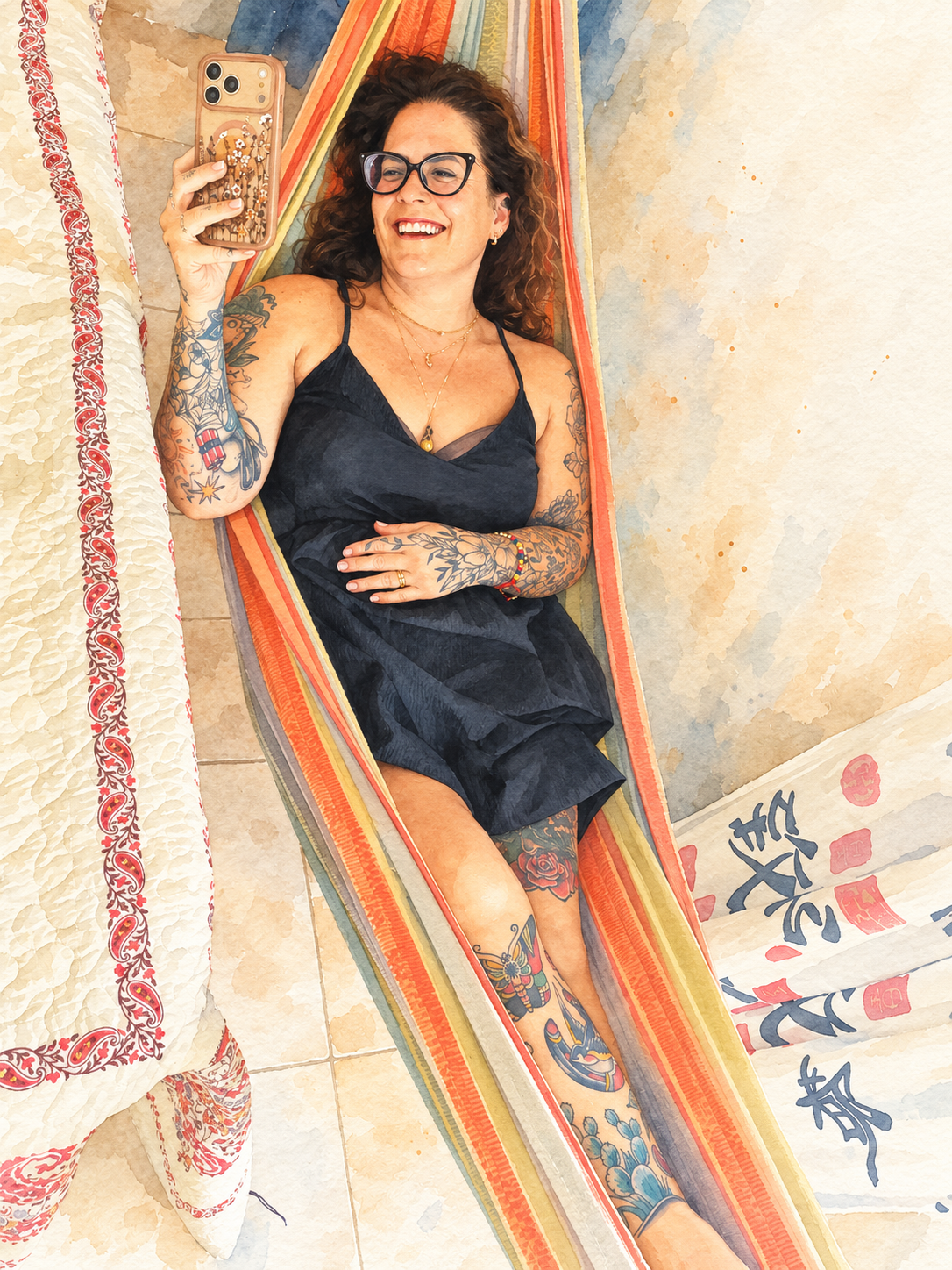
There I was inside his mother’s home in Saldaña, lying in her hammock and talking to my husband all the way back in Arizona. That alone felt strange and wonderful. But what caught me off guard was my own face.
I could see how I was looking at him.
I don’t think anyone had ever photographed me quite like that before—completely unaware that a camera was on me, not posing, not smiling because somebody had told me to smile, simply looking at my husband.
And for the first time, I got to see what I looked like when I looked at Adan.
Apparently Colombia was going to keep showing me things I had never seen before.
Sometimes, even things about myself.
Apparently We’re Family Now
Not long after we had rested, the door opened again and, once more, people I already knew but had never physically met walked through it.
That happened over and over again in Colombia, and I never quite got used to it.
This time it was Adan’s aunt, Tía Martha - the woman he calls his second mother - and her daughter, Paula.
I knew them from WhatsApp and video calls. I had watched Adan talk to them. I had seen the beautiful clothes Tía Martha made and the woven bracelets Paula created by hand. I knew their faces, their voices and little pieces of their personalities.
But screens flatten people.
And suddenly there they were, full-sized and standing directly in front of me, hugging me.
Hello.
Apparently we’re family now.
I had brought purses for the women in Adan’s family, and they had things for us too. Almost immediately, Paula sat down at the kitchen table and began working on one of her woven bracelets by hand. People were talking, gifts were being passed around, somebody was taking pictures, and everyone was trying to communicate across a language barrier that, by this point, seemed to matter less and less.
Then Adan’s mother gave me a beautiful Colombian scarf.
When I say I love this scarf, I mean I absolutely adore this scarf. It became precious to me almost instantly, not because of what it cost, but because of everything that became attached to the moment she gave it to me.
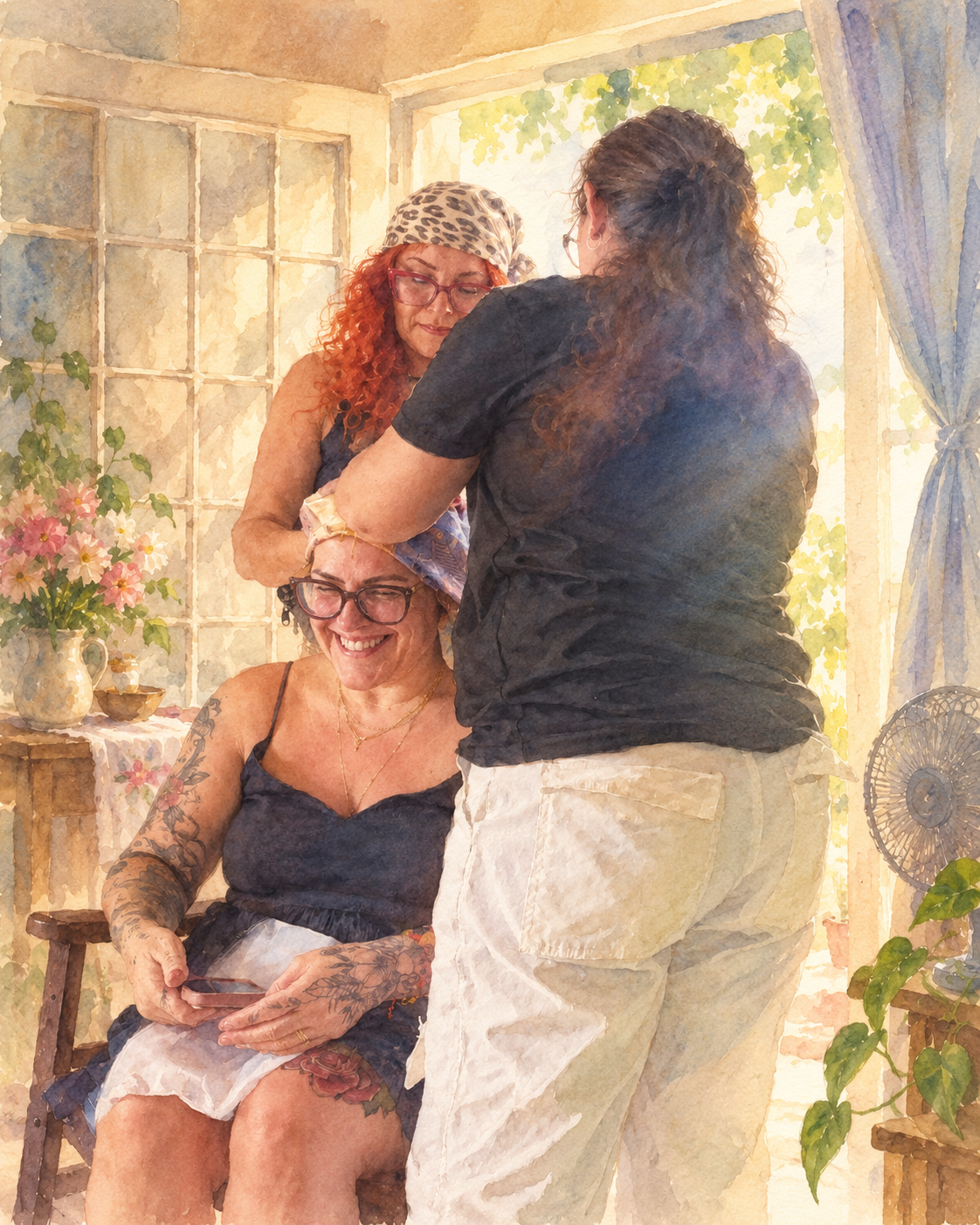
And then the women started wrapping it around my head.
His mother stood on one side of me and Tía Martha on the other, adjusting it, tucking it, standing back to inspect their work and then coming toward me again to fix something else.
I don’t think either one of them intended the moment to feel ceremonial.
But it did to me.
I was standing there in my black dress, carrying the woven purse Luis Fernando had bought me the day before on Monserrate. Now, hours away in the Colombian countryside, my husband’s mother and the woman he called his second mother were carefully wrapping this beautiful Colombian scarf around my head.
For a moment, something inside me became very still.
I wasn’t pretending to be Colombian. I wasn’t claiming a culture that wasn’t mine. That wasn’t what the moment meant.
I was simply being welcomed into something.
Into their kitchen.
Into their day.
Into their family.
And for someone who had spent so much of her life constructing home and belonging for herself, there was something extraordinary about being invited into a belonging I had not built with my own hands.
I just stood there and let them fuss over the scarf.
Where Her House Will Stand
Almost as soon as Tía Martha and Paula arrived, there was somewhere we needed to go.
The land.
Calling it “the farm” never quite feels right to me, because by then this place already meant far more than that. Almost from the beginning of my relationship with Adan, I had heard about the house he wanted to build there for his mother.
Not simply a house.
Her house.
Her permanent home.
The place he wanted to give the woman who occupied such an enormous part of his heart.
The project had been quietly present in our relationship almost from the beginning. I had watched videos from Arizona as the land was cleared. I had seen photographs and heard the plans. We had talked about the concrete slab, what had already happened, what needed to happen next and where things would eventually go.
It was never some vague dream that belonged to an undefined future.
In Adan’s mind, this house was going to happen.
Someday, we were going to build his mother a home.
That had simply become part of our life together.
And now I was about to stand on the ground where he imagined it.
First, however, apparently I needed shoes.
I had arrived in Saldaña with two pairs of flip-flops despite the fact that my husband had specifically told me before I left Arizona to bring boots. In my defense, I had packed for Bogotá, Saldaña, dinners, work, international flights and approximately seventeen versions of Colombian weather.
In his defense, he had clearly said boots.
Apparently he had known what he was talking about.
So before I could participate in this deeply meaningful journey into my husband’s family history, we had to go shoe shopping.
At a little store in town, I found a pair that seemed suitable. The woman told me the price, I attempted to convert Colombian pesos into American dollars inside my increasingly overheated brain, and concluded they were too expensive.
So we left.
Halfway down the street, my brain finally finished the calculation.
Wait.
How much had she said?
I converted it again.
Oh.
Never mind.
We turned around.
Back inside the store, I discovered another small cultural difference: there were no disposable little foot covers for trying on shoes. Instead, the woman put my bare foot inside a plastic bag and slid the shoe over it.
Honestly?
Effective.
I bought the shoes.
Now I was ready.
The four of us—Adan’s mother, Tía Martha, Paula and me—piled into what may have been the most interesting vehicle of my Colombian adventure. As seemed to happen everywhere I went with this family, they insisted that I sit in front so I would be comfortable.
Very sweet.
The passenger window did not roll down.
It was approximately ninety-five degrees outside.
Less sweet.
So I sat there in my newly acquired farm shoes, slowly roasting and feeling extremely loved.
By then I had learned that both things could be true at once.
But underneath all of the comedy was this growing sense of anticipation. Monserrate had been breathtaking. Bogotá had been exciting. The emerald dealer had felt almost surreal. This was different.
This place had existed in my marriage before I ever booked a plane ticket.
When we arrived, I lost cell service almost immediately.
Which also meant I lost Google Translate.
Of course I did.
His mother began walking me around the property, speaking Spanish and pointing while I tried desperately to follow. She showed me what had been cleared and what had already been done. She pointed toward different parts of the land and explained what would happen next and where things would eventually go.
I understood pieces of the words.
But somehow, I understood much more than that.
She could already see the house.
That was what struck me.
There was pride in the way she showed me the land, but not the kind of pride that comes from showing off something you own. It was quieter. More hopeful.
She could see her future there.
And because I knew her son, I understood why.
I knew how much this mattered to him. I knew the way he worried about his mother from Arizona. I knew how badly he wanted to give her something permanent and safe and hers. Even while he was building a life four thousand miles away, part of his attention remained on this piece of ground in Tolima.
So I began taking pictures and videos for him.
I filmed everything I thought he might want to see: the angles of the property, the places his mother was pointing toward, what had changed since the photographs he already had. I tried to remember what she was telling me so I could carry details back to him, because once again I had found myself standing somewhere my husband desperately wanted to stand himself.
Then his mother showed me something I had heard about before but had never fully understood.
Around the time Adan and I decided to marry, she had told me that she wanted us to have a piece of her land too. Someday, she said, we could build a house there.
From Arizona, it had sounded almost theoretical. A beautiful future offered by a woman I had not yet hugged.
Standing beside her on the actual property, it stopped being theoretical.
She pointed.
Here would be her house.
Then she pointed somewhere else.
And there?
Ours.
I looked where she was pointing and tried to imagine it.
Her home here. Ours nearby. People moving between the houses. Food carried back and forth. Family appearing without knocking. Dogs wandering around. Someone calling across the property. Children. Hammocks. Noise. The kind of life I had only been living inside for a few days but had already begun to recognize.
A place for all of us.
There was something extraordinary about how naturally she included me in that future. She wasn’t showing me where her son could sleep when he came home to visit.
She was showing me where we belonged.
And standing there beside her, I believed her.
I still do.
We are going to build that house for his mom.
And when we do, that woman is getting air conditioning.
As we continued walking, the land began revealing itself in smaller ways.
I heard snorting somewhere nearby and immediately had to investigate.
Pigs. Actual live pigs.
I had never spent much time around pigs before, and within about thirty seconds I discovered they were far more social than I had realized. The moment I walked toward them, they seemed genuinely interested in me. They snorted, moved closer and watched me with what looked like enormous curiosity.
Then one of them climbed up against the wall of her pen and posed.
I do not know how else to describe what happened. She posed. That pig had apparently spent her entire life preparing for the arrival of an American woman with an iPhone.
I realized then, this would be the day I met the world’s most photogenic pig.
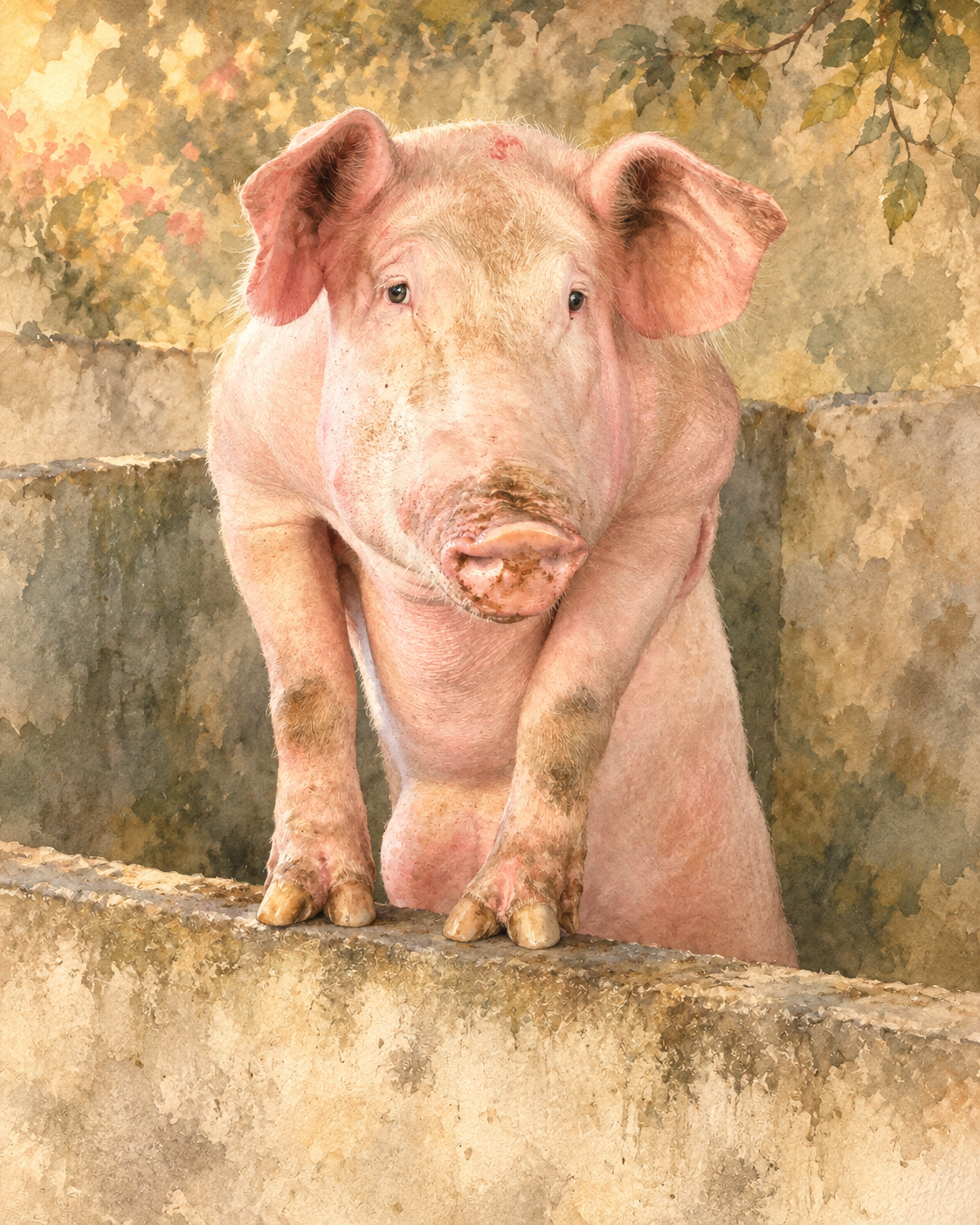
She had tiny piglets running around at her feet, and nearby were chickens, dogs and animals seemingly everywhere. I was madly in love with it all.
Then I started noticing the trees.
Bananas.
Actual bananas growing on trees.
I was embarrassingly excited about this. I had eaten bananas for nearly fifty years and had somehow never seen them growing anywhere except in the produce department.
There were mangoes. Lemons. Fruit everywhere.
But as we went farther into the property, I realized his mother wasn’t merely showing me plants and animals or where her house would go.
She was showing me history.
At one point, she stopped beside the remains of an old structure and explained that this had been her Abuela’s home.
Her grandmother had lived there.
I looked at what remained differently after that.
Until then, so much of Adan’s family history had reached me through photographs and names and stories. Things remembered from another country. People mentioned on WhatsApp calls.
Now I was standing beside the physical remains of a home where another generation of this family had actually lived.
His mother’s grandmother had stood on this land.
His mother came from this place.
And now her son, living thousands of miles away in Arizona, wanted to build the next house here.
There was something incredibly moving about that continuity.
A home had stood here before.
Another one would stand here again.
The land had held this family long before I knew any of them, and somehow his mother was standing beside me now, showing me where I could become part of what came next.
Then I noticed a little path leading downhill.
Something about it pulled me immediately.
I took out my phone and began recording for Adan.
“Look at this path. I love this. I want to build a house down here. I wonder what’s down here.”
And then I started walking.
I kept filming as I went, talking to my husband the way I had been talking to him throughout this entire trip, almost as if the phone could make it possible for him to walk beside me.
The trees thickened around us. Banana leaves and branches stretched overhead, with sunlight slipping through in pieces.
Then, through the trees, I saw water.
The river.
I know the exact moment I understood what I was looking at because I was still recording.
“Oh my gosh. This is the river you were talking about.”
The day before, Adan had casually told me, “You’re going to the river.”
By then I had grown accustomed to statements like that turning into entire experiences he had somehow arranged from Arizona, so naturally I assumed the river was another destination.
Maybe we would drive somewhere.
Maybe his family would take me on another excursion.
No.
The river was right there.
At the bottom of his mother’s land.
Only a short walk from where her house would someday stand.
I stood there staring at it, almost laughing at how completely I had misunderstood him.

The water was low because it was summer, but it moved quietly beneath the trees. What struck me most was how different everything felt down there. Only a short distance away was Saldaña—the motorcycles, trucks, stores, music and constant activity.
Beside the river, all of that disappeared.
It was cool and green and peaceful.
And suddenly the house made even more sense.
When Adan talked about building a home for his mother, I had always understood the practical part of that dream. I understood wanting her to have something permanent. Something comfortable. Something of her own.
Standing beside the river, I understood that he wasn’t simply trying to give her walls and a roof.
He wanted to give her this.
Her land.
Her history.
Her family nearby.
The fruit trees.
The animals.
The river at the bottom of the path.
A home rooted inside the place she came from.
There were relatives cooling themselves in the water, and his mother began introducing me to everyone. At least, I assume that was what was happening. I had no cell service, no Google Translate, and by then I had completely lost track of the Colombian family tree.
Somebody’s cousin. Somebody’s aunt. Somebody related to somebody.
The details were gone.
The meaning wasn’t.
Family.
Eventually we walked back toward one of the houses on the property, where his mother’s aunt made us coffee.
Black coffee.
I do not drink black coffee.
I drank that coffee.
It was incredible.
And somewhere during that afternoon, sitting on family land with a cup of coffee in my hand and the river only a short walk away, something about the trip shifted.
I had gone to Colombia wanting to understand where my husband came from. Bogotá had begun answering that question through people and places—Luis Fernando’s apartment, Monserrate, Mafe and the kids, the food he loved, the emeralds, the city where his family lived.
This was different.
Here, everything seemed to come together in one place.
His mother was here. His family history was here. The remains of his great-grandmother’s home were here. The house he dreamed of building was here. The place his mother had already imagined giving to us was here.
The river was here.
This was not simply somewhere Adan had visited or somewhere his mother happened to own land.
It was one of the places he carried inside himself.
And standing there, I finally understood why he needed me to see it.
He could tell me about the land from Arizona. He could show me photographs. He could send me videos of the property being cleared and explain where the house would stand.
But there were some things he could not give me through a phone.
I needed to stand there.
I needed his mother to walk me across it.
I needed to see the pride on her face when she pointed toward a house that did not yet exist. I needed to stand beside the remains of her grandmother’s home, follow the little path through the trees and discover the river waiting at the bottom.
I needed to understand that when my husband talked about building his mother a house, he wasn’t really talking about construction.
He was talking about home.
And now I knew what he meant.
Saldaña. With My Mom.
Later, after I had returned to Arizona and had finally begun telling Adan this entire story, I asked him a question.
Because of our language barrier, Adan and I sometimes text each other even when we are sitting right beside one another. Our iMessages translate automatically, and when there is something I really want to make sure he understands exactly, texting can save us from working our way through the same sentence three different ways.
So I texted him:
Of everything you arranged for me from Arizona—Monserrate, the emeralds, the food, Bogotá, Saldaña, the time with your family—which was the most important thing for you that I experience?
He answered so quickly I wasn’t even sure the message had reached him.
Out loud.
In English.
“Saldaña. With my mom.”
There was no thoughtful pause. No weighing the relative merits of Colombian emeralds versus Monserrate. No consideration whatsoever.
Saldaña.
With my mom.
Then he looked at me as though texting him the question had been completely unnecessary.
“Do I even need to text you back?”
Apparently not.
And once I knew that, I saw the trip differently.
The emeralds were extraordinary. Monserrate was breathtaking. Bogotá had been exciting and beautiful and full of things he wanted me to experience.
But the thing my husband most wanted to give me wasn’t something spectacular.
It wasn’t jewelry or a tourist attraction.
It wasn’t even, necessarily, Colombia itself.
It was his mother in Saldaña.
Her town. Her home. Her shop. Her land. Her family. Her food. The house. The river. The place that had shaped the people who shaped him.
He couldn’t be there to take me himself.
So he did the next best thing.
He sent me there.
Before We Went to Sleep
By the time we returned from the land, I was more exhausted than I can adequately explain.
It had been an enormous day: waking in Bogotá, leaving the family I had already somehow become attached to, the long drive, the pharmacy, lechona, arriving in Saldaña, meeting Tía Martha and Paula, the scarf, the shoes, the land, the house, the pigs, the river.
Emotionally, physically, culturally, gastrointestinally—there was very little of me left.
But I didn’t want the day to end.
We went back to his mother’s shop and opened it for a while. She made us virgin micheladas. There was ice cream. People came and went. Paula was still working on the bracelets she had been weaving throughout the day.
And for a while, the four of us simply sat there together.
Adan’s mother.
Tía Martha, the woman he calls his second mother.
Paula.
And me.
I was physically exhausted and still not really able to eat very much, but I also knew how little time I had with them. I didn’t want to go upstairs. I didn’t want everyone to go home. I didn’t want to lose an hour of something I had traveled this far to experience.

Eventually, though, the day won.
We went upstairs to his mother’s apartment.
And before we went to sleep, there was something I wanted to say.
There was no graceful way for me to say all of it in Spanish, so I did what had become completely normal by then.
I pulled out Google Translate.
I told them:
“Before I go to sleep, I just want to say thank you for welcoming me into your family. It is an honor to be Fabricio’s wife and to carry your family name. I am so grateful that I was able to come here and meet the three of you, these very special women. And thank you for raising such a wonderful man that I now get to call my husband.”
Even writing those words now makes me emotional, because somewhere in Colombia, something had quietly begun changing in the way I thought about my husband.
With me, in Arizona, he had always been Adan.
With his family, he was Fabricio.
That was what they had always called him. He had explained it to me before in this sweet, matter-of-fact way: in the United States, people almost always assume you will go by your first given name. In Colombia, he told me, you might go by either of your given names. His family had always chosen Fabricio.
So all around me in Colombia, I kept hearing it.
Fabricio.
His mother called him Fabricio. Tía Martha called him Fabricio. His father, his sister, the people who had known him long before I ever existed in his life—they all called him Fabricio.
At first, it was simply the name his family used.
But slowly, almost without my realizing it, Fabricio was becoming part of the man I knew too.
Tía Martha answered first.
She told me they were grateful that I had shared this experience with them and that I had taken the time to come, because they understood that it had not been easy.
Then she thanked me for something I had never expected anyone to thank me for.
For loving him.
For respecting him.
For being part of the family.
There was something about hearing that from the woman he called his second mother that went straight through me. I had spent so much of the trip thanking them for welcoming me, and suddenly they were thanking me for the way I loved him.
Then his mother spoke.
“To you, my Molly.”
That alone nearly destroyed me.
She thanked me for taking care of her son and for loving him so deeply. She acknowledged that living together and building a life together could be complicated, but she could see how much effort we both gave because we loved one another, and because, in her view, God was present in our bond.
Then she began talking about the trip itself.
She told me that one of the things she admired most was the trust I had placed in her son.
I had come to Colombia without really knowing the country. I didn’t truly speak the language. Before I walked through those airport doors, I had never physically met any of the people who were going to take care of me.
From her perspective, that had been an extraordinary act of trust.
She said that, in a way, it had been a wild adventure.
Because how could I really have known?
What if I had come all this way and found completely different people waiting for me?
What if they had not been kind?
What if they had not been waiting with love?
The question almost startled me, because I had never thought about the trip that way.
But she had.
And then she told me that they had been waiting with love.
They had been eagerly waiting for me because, through their son, they had already begun to care about me before I arrived. They had been waiting with affection, anticipation and joy.
And suddenly I understood something I hadn’t fully understood before I went to Colombia.
I had spent months thinking about the moment I would finally meet them.
I had imagined walking through those doors and seeing people I already felt connected to.
I hadn’t really stopped to consider that they had been waiting to meet me too.
So I answered her.
“I knew.”
I knew what kind of people would be waiting for me because I trusted Fabricio completely.
That was the truth.
The trip may have looked brave or reckless or wild to other people. I understood why. I had gone alone to a country I had never visited, barely speaking the language, to travel with people I had never physically met.
But I had never been afraid of them.
Not once.
I trusted my husband.
And because I trusted him, I trusted the people he loved.
What I hadn’t understood before arriving was what Fabricio had been telling them about me.
Over those first days, I had begun hearing myself described through my husband’s eyes. I saw the way his family welcomed me because of the woman he had told them I was. I heard how he had talked about me, how he had described our relationship, what he had told them about the way I loved him.
And for perhaps the first time, I was beginning to see myself through those eyes too.
I told them that the trip had deepened our love for each other in ways I had never expected, and I thanked them again.
For the conversation.
For the family.
For the trust.
For the scarf and the bracelets and the food and the land and the river and the house that didn’t exist yet.
For the gift of being there.
It was beautiful and emotional and completely exhausting.
It was also approximately ninety-five degrees.
Eventually, there was simply nothing left in me.
We went to sleep.
And somehow, the next morning, Saldaña still had more to give me.
♥️
