I Went to Colombia (Part Six)
Doing Life in Saldaña
Monday morning in Saldaña moved slowly.
The doors and windows of the apartment were open, fans were running, and outside the town was already fully awake. Motorcycles passed constantly on the road below, punctuated by the occasional enormous truck rumbling through. People were opening shops, going to work, moving through their Monday morning while inside the apartment we eased into the day.
For all the intensity of the previous twenty-four hours—the drive from Bogotá, lechona, meeting Tía Martha and Paula, the scarf, the land, the river, the conversation before bed—Monday began almost startlingly ordinarily.
Breakfast. Coffee. Arepas. Fruit. Really, really good fruit.
By then, even my gastrointestinal situation was beginning to show tentative signs of cooperation. We were nowhere near declaring victory, but diplomatic relations appeared to be improving.
I took a shower and discovered another problem: I had no conditioner. This was not, objectively speaking, an emergency. But I was in Saldaña in ninety-something-degree heat, and if my hair was going to have even the faintest chance of behaving like something attached to a human head, conditioner was going to be necessary.
So Paula offered to walk into town with me, and I loved that.
There was nothing remotely remarkable about what we were doing. We weren’t headed to a landmark. Nobody had planned an experience for me. There was no driver waiting, no emerald dealer, no funicular carrying us into the clouds. We were simply two women walking down the street on a hot Monday morning because one of us needed conditioner.
We couldn’t really talk to each other. Paula spoke Spanish. I mostly did not. So we walked together through the heat, peeking into shops and looking for somewhere that sold what I needed.
At one point, we passed a storefront with a bright yellow women’s bodysuit hanging in the window. Across the front, in big letters: Chicago. Of course. I had traveled thousands of miles from home, crossed into the Colombian countryside, arrived in a small town in Tolima, and apparently Chicago had beaten me there.
Naturally, I took a picture.
Eventually we found the conditioner, which came in little packets. I gave Paula some cash and she handled the transaction for me, selecting what we needed and paying while I stood beside her being approximately as useful as I had been in most Spanish-language retail situations up to that point.
She was incredibly sweet about all of it. There was something lovely about the practicality of the whole thing. We didn’t need to have some deep conversation for me to enjoy being with her. She knew what we needed. I trusted her to handle it. We bought our conditioner and walked home.
That was it, and somehow that was precisely why I remember it.
The day before, his family had shown me their land and their river and the remains of a home where another generation had lived. That morning, Paula and I bought hair conditioner. Both things made me feel closer to them.
By the time we got back to the apartment, fixed my hair and settled into the rest of the morning, I was starting to understand that some of the moments I loved most in Colombia were going to be the ones no one would ever put on an itinerary.
Unfortunately, belonging to Fabricio’s Colombian family had not rendered me independently wealthy, so eventually I had to open my laptop and go to work.
This led to one of the stranger office setups of my professional career. At one point, my laptop was balanced on an upside-down green plastic bowl while I joined a company meeting from his mother’s apartment. The doors and windows were still open. Fans were going. Motorcycles and trucks continued passing outside. It was somewhere above ninety degrees, there was no air conditioning, and behind me Tía Martha had spent much of the morning standing over a hot stove.
Paula, who was suffering right along with me, kept announcing the obvious: “Mucho calor. Mucho calor.”
Yes, Paula. Mucho calor. Very mucho.
But nobody seemed particularly distressed about it. It was simply hot. Fans moved the air around. Doors stayed open. We drank cold things. Life continued.
And in the kitchen, Tía Martha was making ajiaco.
This was not the first Colombian soup I had encountered by then. Two days earlier, I had finally achieved my personal dream of eating authentic changua on top of Monserrate. Was I a Colombian soup expert? Absolutely not. But I was developing credentials.
Ajiaco is the kind of soup that makes immediate sense in cool, rainy Bogotá: chicken, potatoes, corn, herbs, rich broth, avocado, cream. Warm, filling, comforting. It makes slightly less obvious sense in a nearly hundred-degree apartment in Saldaña while a fan valiantly pushes hot air from one side of the room to the other.
And yet somehow, when we finally sat down together, it was perfect.
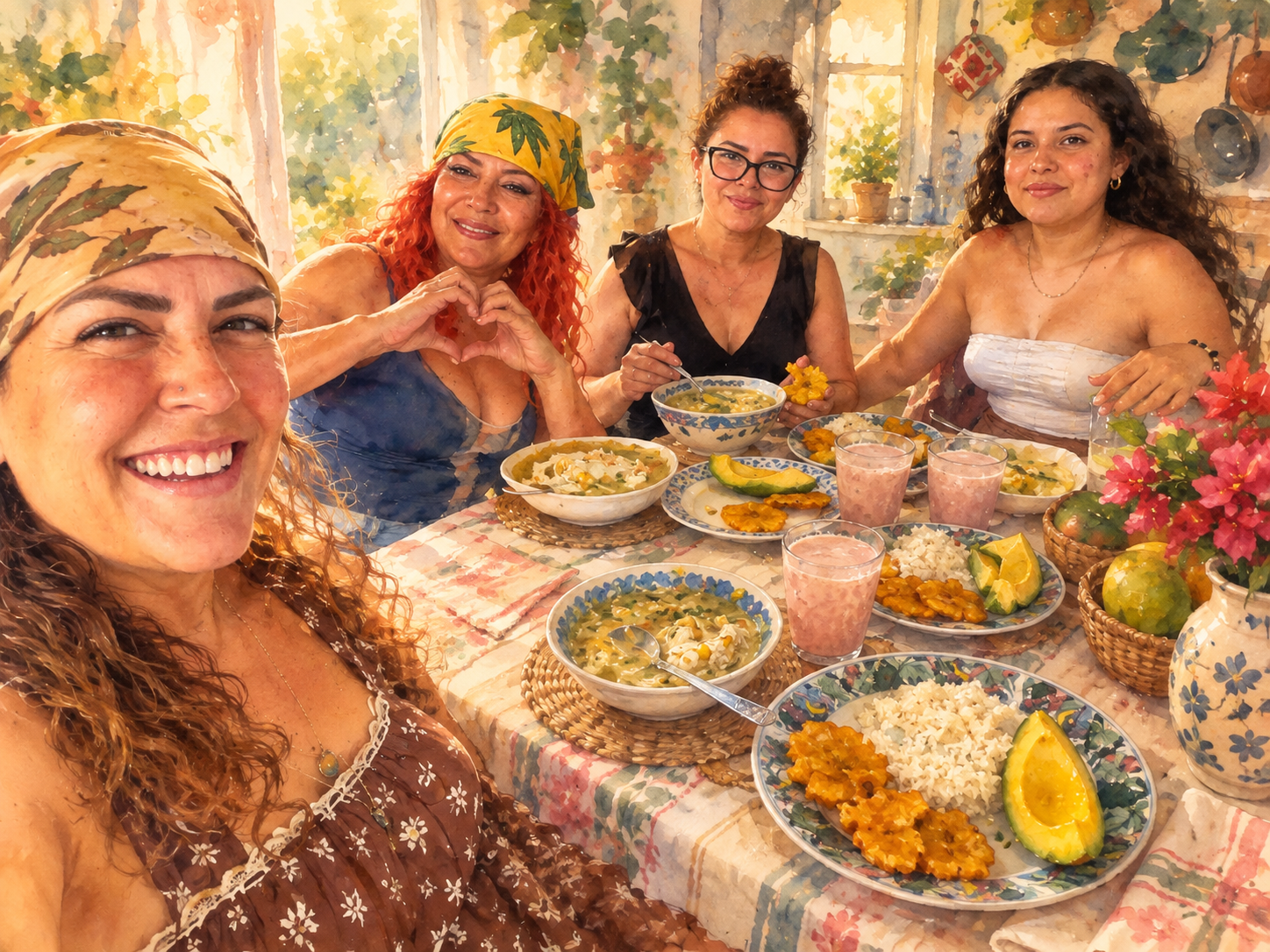
The kitchen table was tiny, and there was food everywhere. Bowls and plates crowded together. Each of us had rice and avocado. There was cream. Corn sat right inside the soup in little pieces of cob. Fabricio’s mother had also made this incredible fresh juice that I still think about, even though I couldn’t remember what fruit it was made from. It was so good I could have happily abandoned all other beverages and lived on that juice for the remainder of my natural life.
The women served us, and then the four of us sat down together: me, Fabricio’s mother, Tía Martha and Paula.
There is a photograph from that lunch that I absolutely love. When I look at it now, I don’t simply see four women sitting around a tiny kitchen table eating soup. I see four women who could probably take over the world if necessary.
Not in some cute, inspirational-poster sense. I mean genuinely formidable women.
Fabricio’s mother had built and operated her own little business downstairs. Tía Martha had spent years creating beautiful clothes and building a life around her talent for fashion and design. Paula had her own nail salon. And then there was me, thousands of miles from my own home, running a sales development team from a laptop balanced on a plastic bowl.
We were not women waiting around for life to happen to us. We knew how to build things—businesses, careers, homes, families, lives. And yet there we were on an ordinary Monday in Saldaña, sitting around a tiny table while two of those women fed me one of the best meals I had ever eaten.
The ajiaco was incredible: creamy and salty and rich with chicken and potatoes, with the corn tucked into the bowl and the avocado and rice alongside it. It tasted nourishing in the most literal sense of the word, like something made to restore a person.
And maybe that is why I remember it as more than simply delicious.
It felt like love.
Not dramatic love. Nobody had spent the morning announcing that they were going to perform some enormous act of care for me. They had simply cooked. They had stood in that hot kitchen for hours while the fans ran and Paula periodically declared mucho calor. They had prepared the food, filled the table, served the bowls and made sure I ate.
There was no performance in it. This was simply what they did.
Sitting there in my brown dress with the little white flowers, still wearing the Colombian scarf Tía Martha had given me the day before because apparently I was now emotionally incapable of taking it off, I had one of those moments when I looked around and thought, How is this my life?
A few months earlier, none of these women had existed anywhere in my world except through the screen of Fabricio’s phone. Now I had walked to the store with Paula. I had watched Tía Martha spend the morning cooking. I knew the sound of his mother’s shop downstairs. I knew how hot her apartment became by lunchtime, where the fans were pointed and how motorcycles sounded when they passed beneath the open windows.
And now the four of us were eating lunch together.
This was no longer simply a place I had traveled to see. For a little while, it was simply where I was spending Monday. And there was something about that ordinariness that made me feel even more at home.
Before I Had Even Left
Somewhere during my time in Saldaña, I also discovered what I still consider one of Colombia’s greatest contributions to civilization: water bags.
Little plastic bags of drinking water. Not bottles. Bags.
I became obsessed almost immediately, because someone had unknowingly invented the perfect product for a woman living without air conditioning in ninety-five-degree heat. You could drink the water, obviously. Or you could put the bag in the freezer for a little while and hold it against the back of your neck until your body temperature returned to a range compatible with human life.
And then you could drink it.
Hydration and personal climate control in one inexpensive plastic pouch. Absolute genius.
After lunch and a short rest, we headed into downtown Saldaña. I had two things I still wanted to do that day. I wanted to see more of the town - especially the big Yo ♥️ Saldaña sign in the main square - and before I left, I wanted to learn how Fabricio’s mother made her arepas.
Walking through downtown felt like being dropped into the middle of a movie. Shops, restaurants, vendors, motorcycles—obviously—people everywhere, noise everywhere, life happening everywhere. And there I was wandering through the middle of it with my little water bag, taking pictures and videos and sending them back to my husband in Arizona.
“I feel like I’m in a movie,” I told him.

We found the sign and took pictures, and somewhere during that walk something happened that I didn’t really expect.
I started missing Saldaña before I had even left.
At one point, Fabricio’s mother, Tía Martha and Paula went into a store and I stayed outside. I sat on a little low wall by myself for a few minutes and simply watched the town move around me: motorcycles passing, people walking by, stores open, people talking, restaurants busy, an ordinary Monday afternoon unfolding in a place that only a day earlier I had never seen in my life.
And I started picturing Fabricio there with me.
Not on FaceTime. Not inside my phone. Actually there: walking those streets with me, sitting beside me, taking me back to the river, showing me things I had missed, going home together to the land his mother had just shown me.
But I could picture something else too. I could picture him there before me.
Fabricio as a boy. Fabricio as a young man. Visiting his family, wandering through that same square, knowing those streets and shops and sounds as part of his own life. He hadn’t grown up in Saldaña, but his family was from there, and he had spent enough time there that the place belonged to his history.
For the first time, I could almost see him inside that history.
And I knew, with complete certainty, that I wanted to come back.
I had loved Saldaña almost from the moment we crossed that bridge and the quiet countryside suddenly gave way to this hot, noisy, motorcycle-filled little town. But sitting there that afternoon somehow sealed it. I felt connected to it. Comfortable there. Like I belonged there.
That created a strange ache because I knew I was leaving. The next day would be my last day in Bogotá, and the next night I would get on a plane and go home to my husband - something I desperately wanted.
I missed him terribly. I could not wait to see him.
And at exactly the same time, I did not want to leave Colombia.
Both things were completely true: I wanted to go home, and I wanted to stay.
I have rarely felt such an immediate connection to a place, but I also knew that what I loved about Saldaña wasn’t only Saldaña. I loved it because I loved him. Everywhere I looked, I was discovering another piece of the man I had married: his mother, his family, their land, the river, the house he dreamed about building, the streets and sounds and food and people that existed inside his memories long before I ever knew him.
There were parts of Fabricio I could only understand by coming here. And now that I had seen them, I wanted more—more time, more stories, more ordinary afternoons sitting outside stores, more time with his family, more of this place that somehow already felt familiar.
I hadn’t even left Saldaña yet, and I already could not wait to come back.
There was still one thing I wanted to do before I did.
I wanted to learn how his mother made her arepas.
His Mother’s Arepas
Later, after we walked back from town, I ended up in the hammock again. Fabricio’s mother lovingly brought me a fresh piece of pineapple with some kind of seasoning sprinkled over it - something spicy and salty and perfect - and I lay there thinking that I had accidentally discovered paradise.
Then his mother started making arepas.
Now, I had attempted to make arepas before. I thought I understood arepas.
I did not.
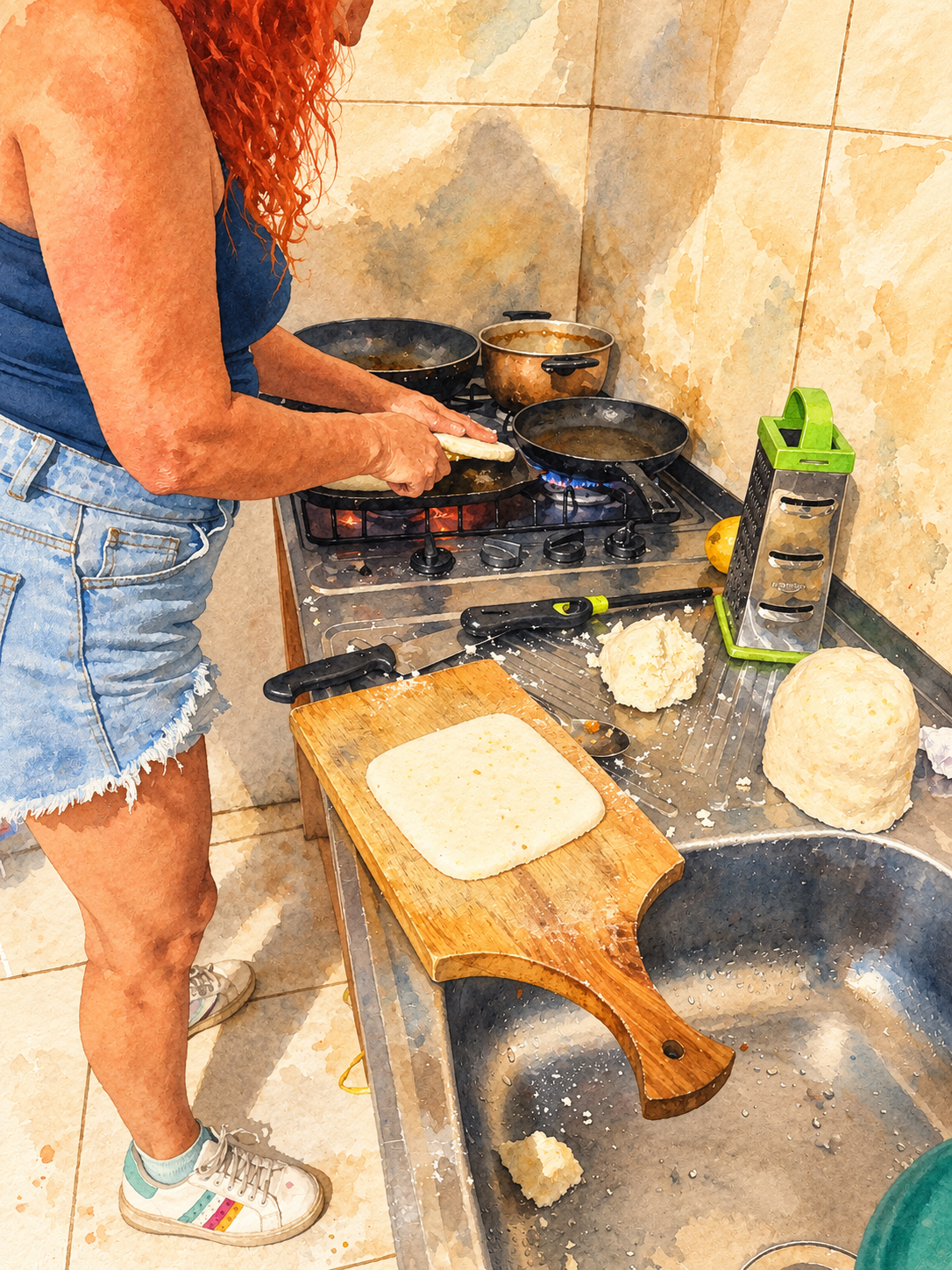
What I understood was buying corn flour from a bag. His mother started with the corn itself. She cooked it, ground it and worked it until she had the masa. She did not open a bag of corn flour the way I did at home. She made it.
I stood there watching her thinking, There is absolutely no way I am ever going to make arepas like this at home.
But I was certainly going to try.
She began forming the arepas by hand, showing me what she was doing, explaining the different shapes and talking me through a process I understood only partially but was trying very hard to remember. She flattened them with a little square cutting board. She usually made hers square because she used them for the sandwiches she sold downstairs, but she made a round one to show me because she knew that was probably how I would make them at home.
I watched her hands. That is what I remember most.
Her hands knew what to do without thinking. How much dough. How thick. How firmly to press. How long to cook them in the little pans she used in her kitchen. These were the kinds of things that were almost impossible to capture through Google Translate because recipes like this are not really recipes.
They are memory. Repetition. Hands that have made the same food hundreds of times.
And as I watched her work, I started to get an idea.
Could I take some home?
Not home to Bogotá.
Home home.
To Fabricio.
Could his mother make arepas here in Saldaña, wrap them up, send them on the drive back to Bogotá, put them on an airplane with me and somehow get them all the way to her son in Arizona?
Absolutely.
And suddenly, we had another mission: get Fabricio’s mother’s homemade arepas back to Arizona.
There were several logistical steps involved here. They would have to survive the drive from Saldaña to Bogotá, spend another night with me there, go into my luggage, travel to the Bogotá airport, board an international flight, make it through the rest of the journey and eventually arrive in Arizona.
With me.
For him.
His mother started making them.
Not some version designed for travel. Not something purchased from a shop. Fabricio’s mother stood in her kitchen in Saldaña and cooked the corn, ground it, made the masa, shaped the arepas with her own hands and prepared five of them for her son.
Five.
I don’t know why that number still gets me. Maybe because by then I understood what I was carrying.
Food is never just food when someone has been away from home. Especially food made by your mother. Especially food from a place you cannot simply return to whenever you want. Especially when your wife has traveled there without you and is now trying to bring some small part of it back.
While his mother worked on the arepas, Tía Martha pulled out a measuring tape.
By then I knew that Tía Martha—the woman Fabricio calls his second mother—was an incredibly talented designer and seamstress. During our video calls she had shown us skirts, dresses and all kinds of beautiful things she had made.
And now she wanted my measurements.
Wait. What?
So there I was in Fabricio’s mother’s apartment in Saldaña, being measured by my husband’s aunt while his mother stood in the kitchen making arepas for me to carry home to him. And I said something that had been floating around in conversations between Fabricio and me for a while.
“We’ve been talking about having a wedding in Colombia someday. Maybe you can make my dress?”
Just like that, something shifted again.
This trip had begun as a journey into my husband’s past. But standing there with a measuring tape around me while his mother made food for her son, we were beginning to imagine - and in tiny ways actually prepare for - a future there too: a dress, another wedding celebration in Colombia with his family around us, a house on the family land, coming back. Family traditions that had existed long before me, and new ones that might someday include me.
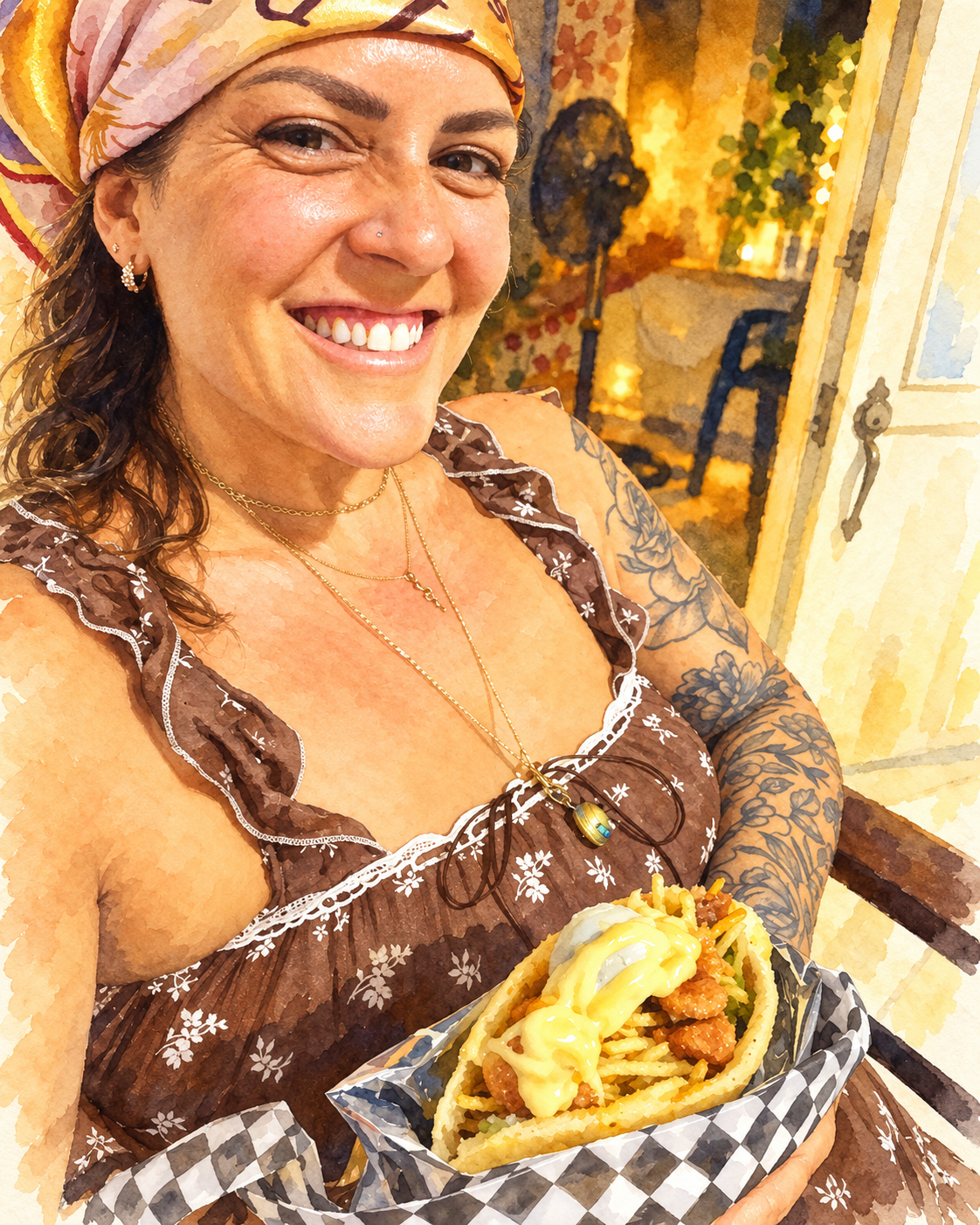
Then his mother made an arepa for me.
Except calling this thing an arepa feels wildly inadequate. It was an architectural achievement containing meat, chicken, sauce, French fries, a quail egg and possibly half the Colombian food supply, all somehow contained inside one beautiful handheld creation.
I took one bite.
It was spectacular.
My digestive system responded: Absolutely not. We have discussed this.
Thankfully, his mother had wrapped it perfectly, so naturally I put the giant arepa in my purse.
Which is a sentence I never expected to write.
Before I knew it, Tía Martha and Paula were getting ready to head home to Ibagué, and suddenly there were goodbyes. Hugs. Last pictures. Paula’s bracelets. Things being gathered. The apartment that had seemed full of activity all day began moving toward departure.
And the arepas were being wrapped for the long journey to their final destination in my husbands hands.
Fabricio’s mother carefully packed five plain arepas for me to take to her son. I watched them disappear into the little package I would carry with me, and something about it felt far more emotional than five pieces of food had any right to feel.
But they weren’t five pieces of food.
They were five little pieces of Saldaña, made from corn his mother had cooked and ground herself, shaped by her hands and wrapped in her kitchen. They had been made in the apartment above the little shop where she worked, in the town his family came from, not far from the land where he dreamed of building her a house.
And now they were coming with me, four thousand miles home to her son.
I had come to Colombia because Fabricio couldn’t. For days, I had been trying to give him the trip through photographs, videos, WhatsApp calls and stories. But for the first time, I could actually bring something home.
Not a souvenir. Not something I had purchased.
Something from his mother’s kitchen.
Something that had passed directly from her hands into mine.
I packed all five carefully.
My job was now very simple:
Do not lose the arepas.
Emeralds and Arepas
Eventually, we had to leave.
We loaded everything into the car and began the long drive back toward Bogotá. By then I was exhausted in that particular way that comes from having lived about seventeen emotional lives in forty-eight hours.
Saldaña disappeared behind us: the motorcycles, the shop, the apartment, the hammock, the square, the river, the land. Somewhere in my bags were five arepas that had suddenly become among the most important objects in my possession.
Hours later, after dark, we stopped at a gas station. Fabricio’s mother and I went inside to use the bathroom while the driver filled the car.
When we came back outside, the car was gone.
Now, logically, I understood that there were many completely innocent explanations for this. Emotionally, however, I was an American woman standing in a dark Colombian countryside gas-station parking lot with my mother-in-law, unable to find our vehicle.
For approximately ten seconds, I became genuinely concerned about the direction the evening had taken.
We wandered around looking for him until we finally found the car.
He had moved it behind a semi.
Of course he had.
Crisis over.
Once I was safely back inside, I remembered something: the enormous arepa in my purse. It had been traveling with me for hours, patiently waiting for my digestive system and me to resolve our differences.
So somewhere between Saldaña and Bogotá, in the dark Colombian countryside, I pulled my mother-in-law’s giant arepa out of my purse and finished it.
No regrets.
By the time we finally reached Bogotá, everyone was waiting. They knew I had a full workday planned the next morning with one of my coworkers, and the family immediately went into caretaker mode.
Go to bed. You need sleep. You need rest. Go.
I was very prepared to obey.
But first there was something waiting for me.
The emeralds.
While I had been in Saldaña, Luis Fernando had picked them up from the jeweler after they were certified. I went into the bedroom and opened them, and there it was: my pear-shaped Colombian emerald, the stone I had chosen only days earlier while Fabricio watched through a phone from Arizona.
I placed it on my hand and stared at it.
It was impossibly green. Beautiful. Rare. Certified. Colombian.
And sitting only a few feet away were five homemade arepas wrapped by my mother-in-law.
I looked at the two things and almost laughed, because somehow they were the perfect summary of everything this trip had become.
Colombian emeralds and his mother’s arepas.
One precious because the world had decided it was.
The other precious because we had.
I had gone to Saldaña wanting to understand more about the man I married.
I came back carrying pieces of his home.
And honestly?
What more could a girl want.
♥️
