I Went to Colombia (Part Four)
The Road to Saldaña
Sunday morning, we woke up early to leave Bogotá.
And for the first time since I had arrived in Colombia, leaving somewhere felt hard.
It had only been a few days, which seems almost ridiculous when I say it now. Barely forty-eight hours earlier, I had walked out of the Bogotá airport and into the arms of people I had previously known mostly through the screen of my husband’s phone. Now I was packing up to leave them.
Not forever, and not even for very long. I knew I would see Luis Fernando, Mafe, Samuel and Antonella again before I left Colombia. But the next time would also be the last time.
There was already an ending hiding inside the middle of the trip.
I wasn’t ready for that yet.
I had become attached to these people so quickly that it almost startled me. I had come to Colombia already caring about them because I loved Adan and because I had spent so much time with them through WhatsApp. But being physically together had changed something. They weren’t people inside my husband’s phone anymore. Now I knew what it felt like when Luis Fernando hugged me. I knew Mafe’s laugh when she was standing beside me. I knew what it felt like to pile into a car with all of them, share meals, wander Bogotá together, be fussed over and photographed and fed until my internal organs began filing formal complaints.
They had become real to me in a different way.
And somehow, I had become theirs.
Not just Adan’s American wife.
Family.
For me, that was not a small thing.
At the same time, I was excited. Really excited. Because I was going to Saldaña with Adan’s mother, and Saldaña was one of those places I had heard about almost from the beginning of our relationship.
It was where she had her store. Where her family had land and had lived for generations. Where Adan wanted so badly to build her a house. It wasn’t simply a location on a map to him.
It was home.
One of the places he truly called home.
Now I was going there.
So that morning I carried this strange collection of emotions all at once. I was sad to leave Bogotá and already beginning to miss people I hadn’t technically left yet. I was grateful for everything that had happened. I was nervous. And I was unbelievably excited to spend time with my mother-in-law and see more of the country, the family and the life that had shaped my husband.
The night before, I had gone to sleep realizing that Bogotá had only been an introduction.
Now we were getting in the car and driving toward the part of his world that felt even more personal.
His mother’s town.
Her shop.
Her land.
The place where her house would stand.
Places I had watched in videos from Arizona were about to become places I could stand inside myself.
So we got into the car and began making our way out of Bogotá.
And I cried.
Not in one dramatic burst. It came and went. I would look out the window and think about the previous two days, and tears would come. Then I would remember where we were going and feel excited. Then I would remember that the trip itself was already beginning to move toward its ending, and I would cry again.
There is something about being a passenger on a long drive when you are already emotional. You don’t have anything to do with your hands. You don’t have anywhere else to go. The world just keeps moving past the window while your mind finally has time to catch up with everything that has happened.
Mine had a lot of catching up to do.
Only a few days earlier, I had been on an airplane looking down at clouds, wondering what it would feel like when I finally walked through those airport doors and met Adan’s family. Now I had memories with them. Real ones.
I had stood on top of Monserrate with his family. I had wandered Bogotá with his mother and Mafe. I had chosen emeralds with my husband through a video call while everyone sat beside me. I had been fed, hugged, photographed, worried over and welcomed in ways I hadn’t known how to anticipate.
And now Bogotá was slowly disappearing behind us.
The buildings began to thin. Traffic loosened. Gray city gave way to green hills and open stretches of road, with mountains rising in the distance and little towns appearing alongside the highway. There were roadside stands, farms, cows, people going about their Sunday mornings. The farther we drove, the more Colombia seemed to change in front of me.
And I kept thinking:
I am going farther into his life. Farther into his family. Farther into him.
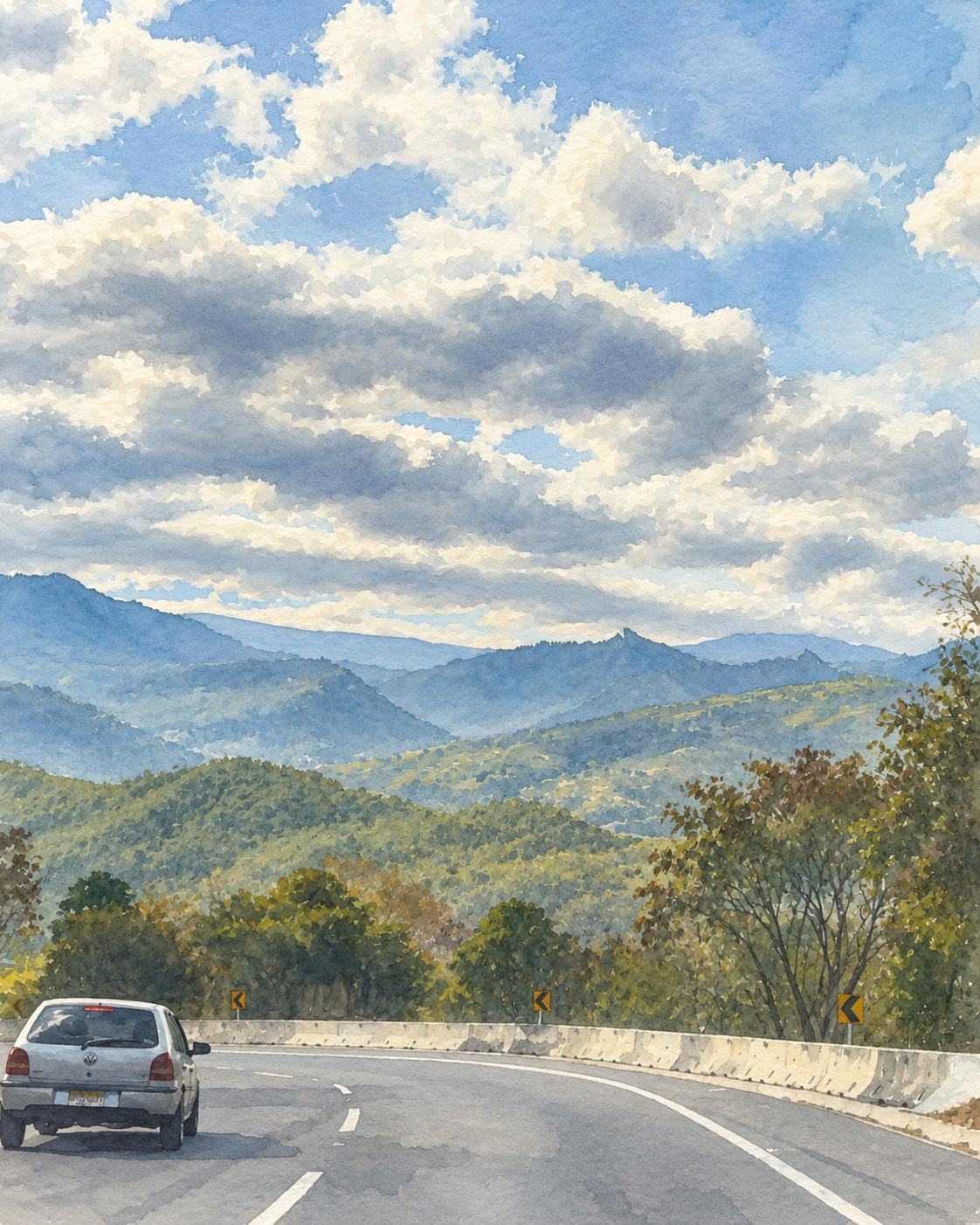
Within about an hour, even the temperature had changed. Bogotá had been cool and gray and rainy enough for coats and layers. As we descended toward the valleys of Tolima, we were heading steadily into heat.
The countryside was beautiful. There were little villages and roadside stands everywhere, the kind of places that made me want to keep asking if we could stop.
Here?
What about here?
Can we stop at this one?
You could have turned the drive itself into an entire day simply by stopping every few miles.
Oddly, parts of it reminded me of one of my favorite places back home: Wisconsin. Green fields, farms, cows—except someone had put mountains in the background and made the cows considerably skinnier.
I kept thinking about how peaceful it felt. How beautiful. How normal.
Before I went to Colombia, people had opinions. Concerns. Warnings. Plenty of people seemed to think that getting on an airplane alone and traveling through Colombia with people I had never physically met was somewhere on a spectrum between courageous and completely insane.
But sitting in that car watching the countryside pass by, I felt completely at ease.
Like I was exactly where I was meant to be.
I was emotional, yes. But I wasn’t afraid of where I was going.
I was nervous because it mattered.
There is a difference.
Saldaña felt more intimate than Bogotá. Bogotá had been full of adventure—Monserrate, emeralds, gold, restaurants, traffic, all these wonderful things Adan had somehow helped orchestrate from four thousand miles away.
Saldaña felt personal.
This was his mother’s world.
This was family land.
This was one of the places my husband carried inside him.
It felt almost sacred.
And I was about to walk into it without him.
Of course, because this was still my trip to Colombia, all of this profound emotional reflection was occurring while I was also dealing with an increasingly urgent gastrointestinal situation.
I had tried to prepare responsibly.
My trip to Mexico the month before had taught me that international travel can have certain... digestive consequences, so I had packed accordingly.
Colombia apparently looked at my preparation and said:
That’s adorable.
Because after two straight days of being lovingly fed meat and bread and soup and cake and fruit and pastries and then more meat and more bread and apparently every carbohydrate available in South America, my body had developed exactly the opposite problem from the one I had anticipated.
Nothing was happening.
Nothing.
I do not eat like this at home. I probably hadn’t been drinking nearly enough water. And somewhere inside me, my digestive system had apparently convened an emergency meeting and unanimously voted:
Nothing else leaves this building.
By Sunday morning, we had moved well beyond mildly uncomfortable. I was genuinely beginning to wonder how long a human body could continue under these conditions before international medical intervention became necessary.
Eventually there was no way around it.
I had to tell my mother-in-law.
There are milestones in every marriage. Meeting the family. Getting married. Combining your lives. Explaining to your husband’s mother, in a language you barely speak, that you desperately need medication because you cannot poop.
We had arrived.
I needed a pharmacy.
The problem was that Bogotá traffic had its own agenda, and we had been trying to get out of the city before it became impossible. So his mother explained to the driver that somewhere along the way, we needed to stop.
Eventually, in a little town, we found something open.
A pharmacy.
At last.
His mother came inside with me because, unsurprisingly, I had not yet acquired the Spanish vocabulary necessary to fully explain the Gastrointestinal Crisis of 2026.
The pharmacist took one look at her and started flirting.
Now, listen.
My mother-in-law is beautiful. She is charming. I understand the impulse. Under different circumstances, I probably would have found the entire interaction delightful.
But I was standing there thinking:
Sir. She does not live in this town. You are not getting anywhere with this woman. Please stop flirting with my mother-in-law and give me the Dulcolax so I can poop.
Eventually, medication was acquired, and crisis management officially began.
We got back into the car, and once again the road stretched ahead of us. Somewhere between the tears, the mountains, the laughter, the pharmacy and the complicated mixture of sadness and excitement sitting inside my chest, I realized I was not simply traveling from Bogotá to Saldaña.
I was crossing into another part of my husband’s story.
And I could not wait to see what was waiting for me there.
But something else was happening on that drive too.
For the first time since arriving in Colombia, I really got to spend time with his mother.
I had technically known her almost as long as I had known Adan. She had called him on WhatsApp during our first date, and he had introduced us without hesitation. Since then, she had been a constant presence in our relationship: calls, messages, advice, laughter, conversations pieced together across languages.
But Bogotá had been different.
She had been there for everything, of course, but she was one person inside this large, loving, slightly chaotic family group that had been waiting for me. Everyone wanted to talk. Everyone wanted to show me something. Someone was always taking a picture or handing me food or asking me a question or trying to tell me a story.
I loved every second of it.
But his mother could disappear into the group a little.
On the road to Saldaña, that changed.
We had hours together. There was no crowd competing for our attention, no schedule of Bogotá adventures, no entire family surrounding us. I could simply be beside her.
And that mattered to me because this wasn’t simply my mother-in-law.
This was Adan’s mom.
The woman whose relationship with him I had been watching almost from the day we met. The woman whose happiness and safety occupied an enormous place in his heart. The woman whose house I had heard him talk about building almost since the beginning of our relationship.
I wanted to know her.
Not only because she was his mother.
I wanted to know her.
And I also knew that understanding her would help me understand more of the man I had married.
We still couldn’t really speak the same language without help, of course. Plenty of Spanish sailed directly over my head during that drive. But by then, loving Adan had already taught me something important: sharing a language and understanding another person are not always the same thing.
Sometimes you find other ways.
And somewhere along that road, between the mountains and the little towns outside the windows, I started getting to know her in a way I hadn’t been able to in Bogotá.

It was special.
And then, because Colombia apparently had impeccable comedic timing, we stopped for lechona.
The night before, Adan had casually told me:
“Tomorrow you’re going to have pork.”
I assumed this meant his mother would cook pork, which seemed like an entirely reasonable interpretation.
What Adan actually meant was that somewhere along the road to Saldaña, he had arranged for us to stop at a place serving lechona.
I had no idea what lechona was.
For most of the drive, the driver and Adan’s mother had been speaking Spanish, so I was happily traveling along with only a partial understanding of what was happening at any given moment. After our pharmacy adventure, though, I understood one thing clearly enough.
About twenty more minutes.
Then lunch.
Great.
By this point, I probably should have known: when my husband casually mentioned something from Arizona, there was usually an entire plan attached to it.
We pulled up to a roadside restaurant, and before I really understood what we were eating, I saw it.
The pig.
Right there.
Front and center.
An entire roasted pig was laid out on an enormous table near the front of the restaurant, practically alongside the road, while servers carved and served it.
And everyone else?
Completely unbothered.
People sat around eating their Sunday lunch as though there wasn’t an entire pig presiding over the restaurant.
Meanwhile, I was staring at it thinking:
Ohhhhhh.
So this is what he meant by pork.
There were enormous figures outside the lechona stand, and at the time I understood almost none of what I was looking at. Adan’s mother tried to explain them to me in Spanish, and I caught just enough to understand that these weren’t random decorations. They belonged to the mythology of Tolima.
The long-haired man crouched with a cigar was El Mohán, one of the region’s most enduring legends: a spirit of the rivers, particularly the Magdalena and Saldaña, said to live in their deepest waters, torment fishermen, and appear along the banks with tobacco in his hand. The other figure was surrounded by the creatures of the Colombian landscape - birds, jaguars, snakes - a fantastical image tied to the same mythology and the region’s relationship with the natural world.
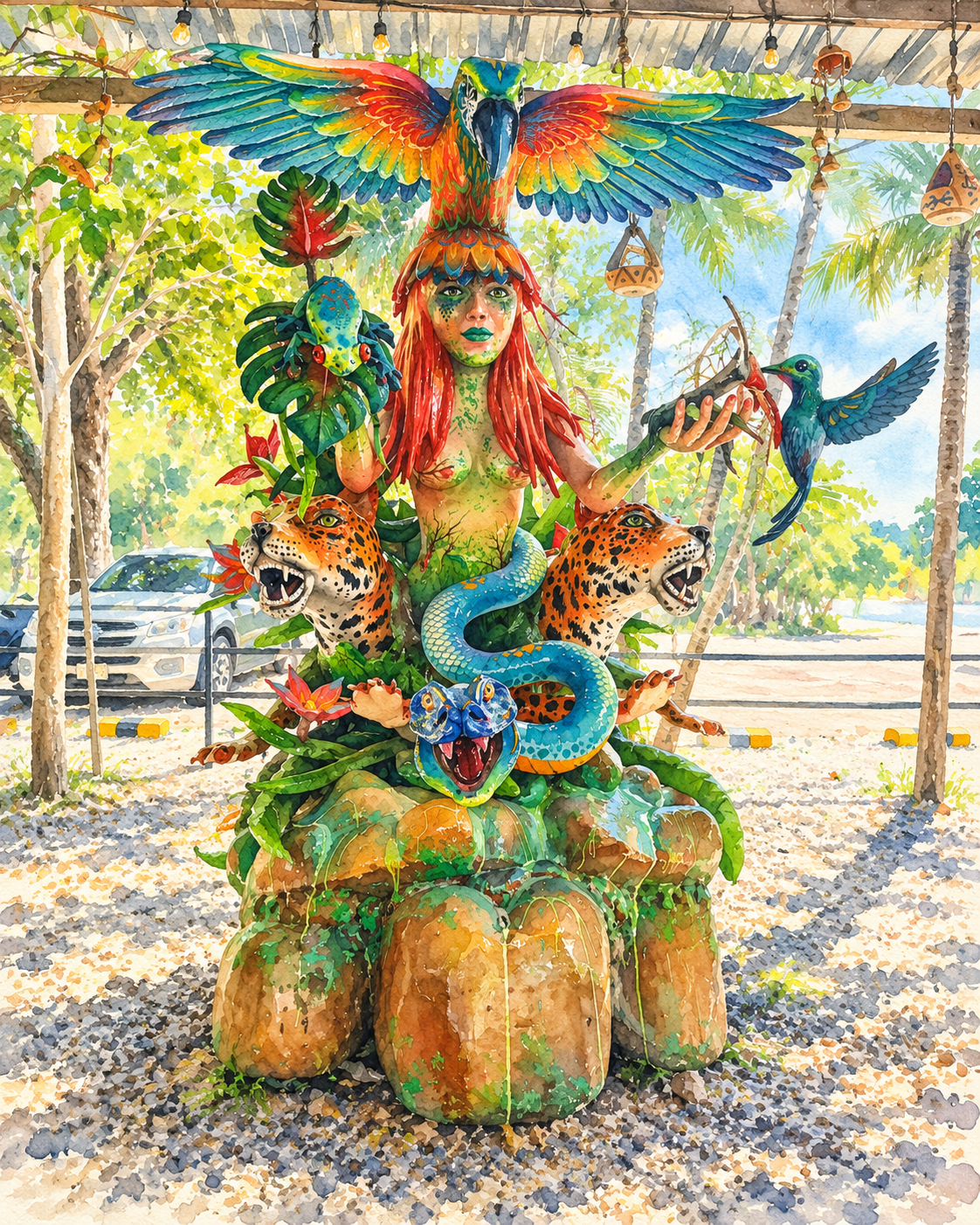
His mother was doing her best to give me an actual cultural education. I was doing my best to follow along in Spanish.
What I mostly understood was: these matter here.
Which, obviously, meant I needed pictures with them.
So I did.
All of them.
At this point, I had accepted my role in Colombia. If something was unusual, beautiful, hilarious, enormous, culturally significant, or simply sitting beside the road looking interesting, there was an excellent chance I was going to take a selfie with it.
Which naturally brought me back to the pig.
I needed that photograph.
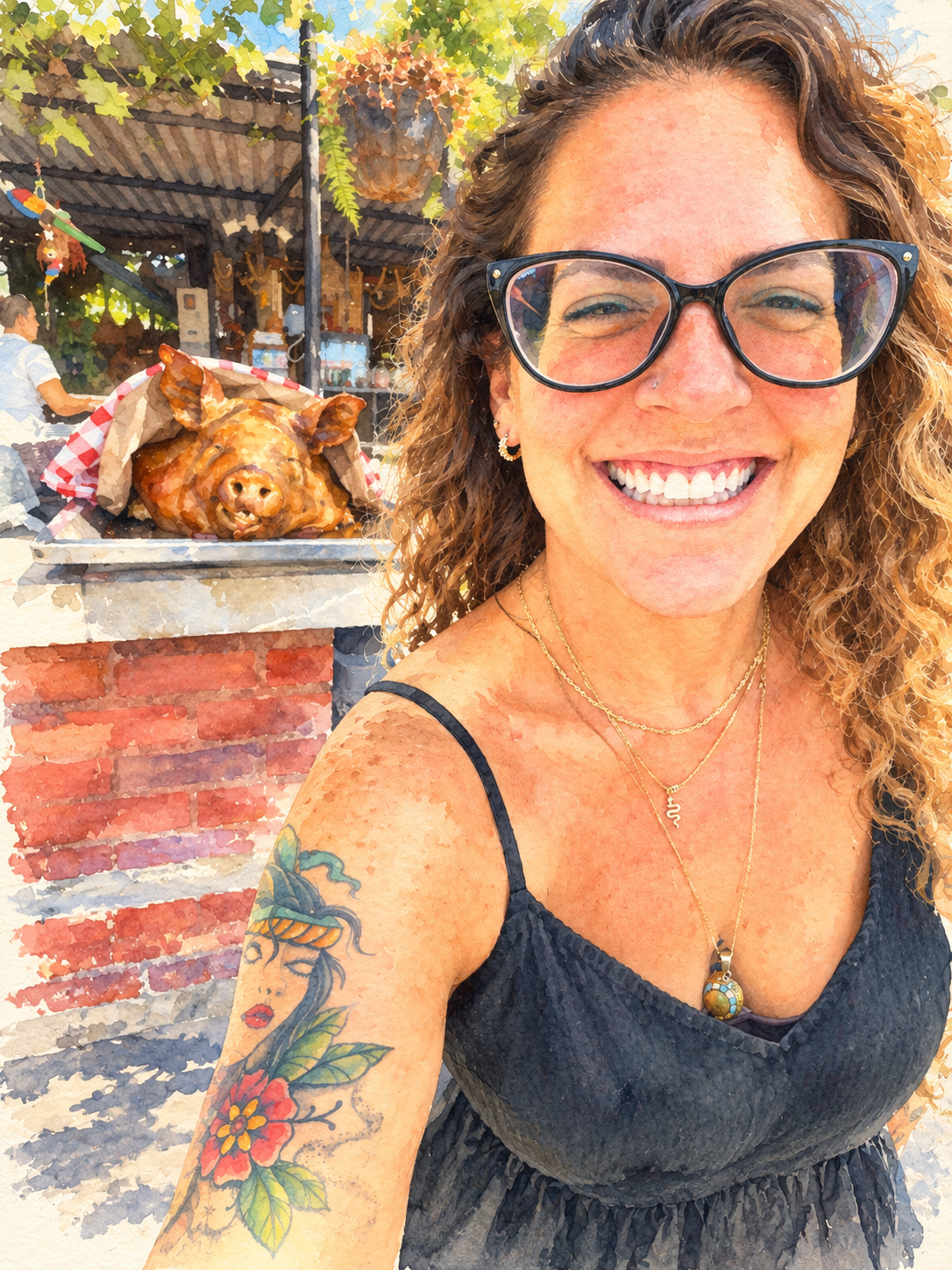
To this day, the picture of me grinning beside that roasted pig’s head remains one of my favorite photographs from the entire trip.
There I am, thousands of miles from home, traveling through Colombia with my mother-in-law, emotional about the family I had just left in Bogotá and excited about the family and history waiting for me in Saldaña.
Deeply constipated.
Standing beside an entire roasted pig.
And having the time of my life.
To say that travel is complicated would be an understatement.
We ate our lechona, climbed back into the car and continued down the road.
Full of lechona and armed with the proper medication this time, I sat beside the woman I had come all this way hoping to know better.
A short drive later, we arrived in Saldaña.
♥️
