I Went To Colombia (Part Three)
Who Cries Over Soup?
The next morning, Colombia apparently decided that six o’clock was a perfectly reasonable time to begin the day.
Luis Fernando’s apartment was already coming alive around me. It was a sweet little two-bedroom place in Usaquén, a neighborhood I had fallen for almost immediately. I loved the apartment. I loved the streets outside it. I loved the little shopping area we had walked to the day before. I was falling deeply and somewhat alarmingly in love with Bogotá, and even faster with the people whose home I had woken up inside.
There were four adults and two children sharing the apartment, which meant six people and one bathroom attempting to become presentable at roughly the same time. I am still not entirely sure how we managed it, but somehow everyone showered, dressed, found their things, located the children, and made it out the door.
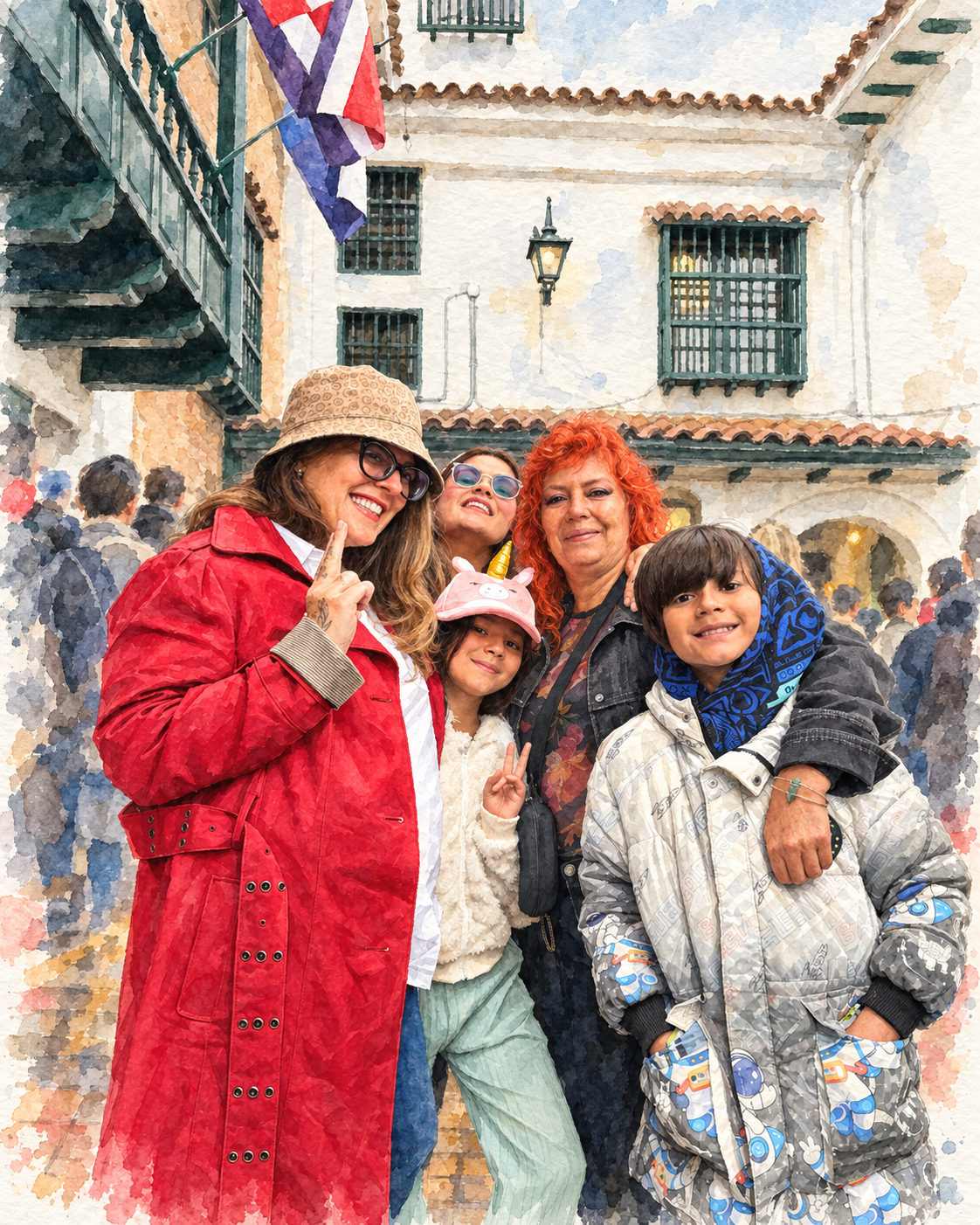
I put on my red coat, boots and hat because that morning we were going to Monserrate.
And Bogotá gave us exactly the kind of weather Bogotá ought to give you for Monserrate: chilly, gray and drizzling.
By the time we reached the base of the mountain, the city was already wide awake. A marathon was happening nearby, so runners and spectators moved through the streets while food vendors worked the crowds and people seemed to be everywhere at once. The line for the funicular was already long, and we joined it in the damp morning air, slowly making our way toward the entrance.
Then we began climbing.
The funicular carried us steadily upward until Bogotá started falling away beneath us, and by the time we reached the top, the entire morning seemed to have shifted into something almost otherworldly.
There was mist everywhere.
It moved through the trees and softened the edges of the city below. Bogotá stretched beneath us, enormous and hazy, while clouds settled low around the mountain. Ahead was the church, and before we even reached it, we could hear the Mass being carried outside through loudspeakers.
The sound of the service floated through the drizzle.
I grew up with two very devout Catholic parents. My relationship with religion as an adult is more complicated, but Catholic churches still do something to me that I cannot entirely explain. There is a familiarity in them that reaches me before my adult brain has time to sort out how I feel about any of it. The sounds, the rituals, the candles, the rhythm of the Mass - they belong to some very old part of me.
And now there I was, high above Bogotá, walking toward a Catholic church in the rain with my husband’s family.
Before we went inside, though, we wandered through the little market behind the church.
Colombian flags were everywhere.
That was something I had begun noticing almost immediately after arriving: Colombia seemed to wear its flag openly. It wasn’t something tucked away on government buildings or brought out for national holidays. It appeared in shops, windows, markets, restaurants, clothing. There was this visible, everyday pride in being Colombian that I found incredibly beautiful.
And then, somewhere among those little stalls on top of Monserrate, I found one of my great personal Colombian missions.
Changua.
Months before the trip, back in Arizona, I had made changua in my own kitchen. Milk, eggs, cilantro, day old bread - this strange Bogotá breakfast soup that I had somehow become fascinated with before I had ever set foot in Colombia. Ever since then, I had been telling Adan that someday I wanted to eat the real thing so I could finally understand what changua was actually supposed to taste like.
Apparently “someday” had arrived.
There I was on top of Monserrate, in the cold Bogotá rain, eating authentic changua with his family.
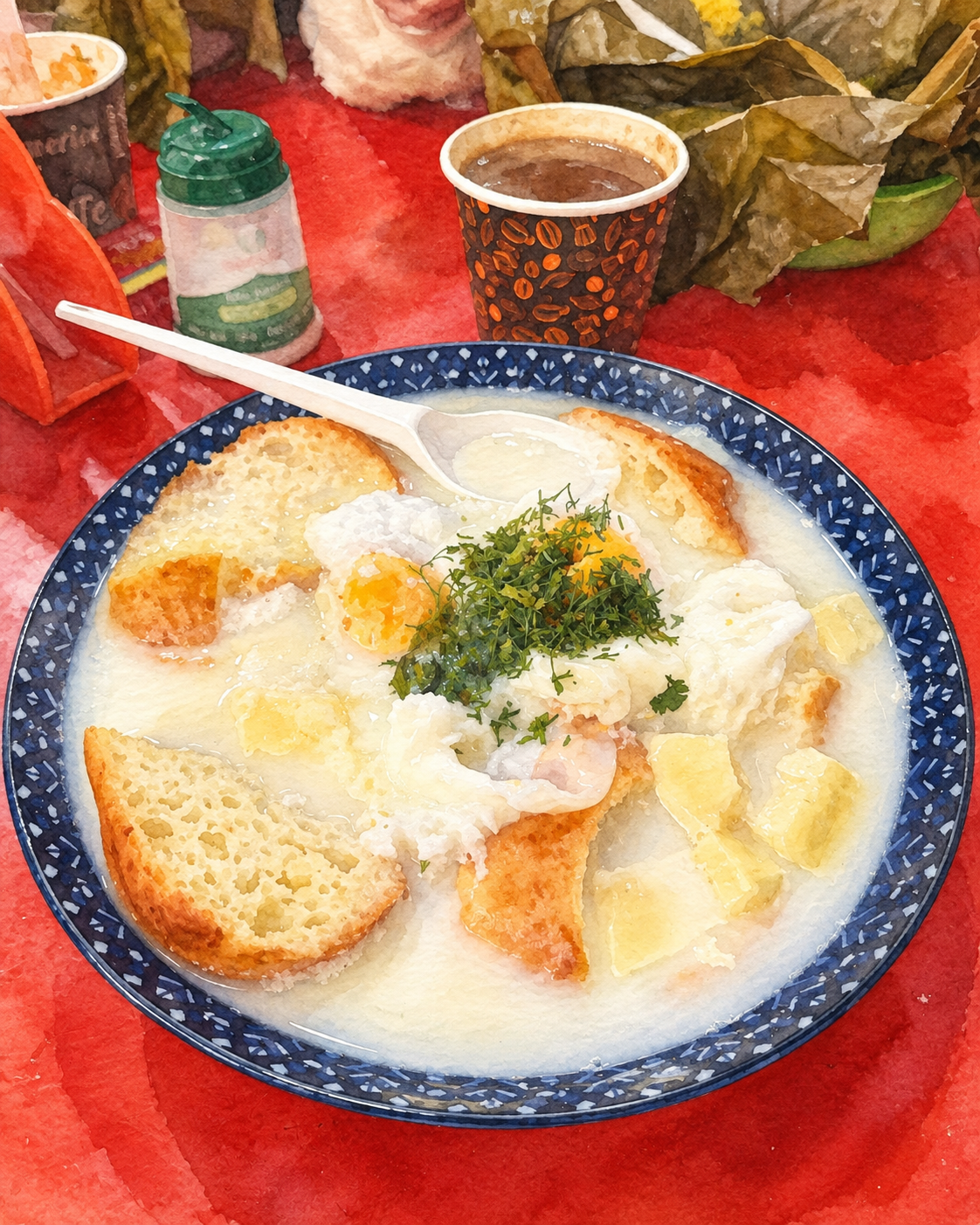
There was food everywhere. Colombian tamal. Other soups. Coffee. Hot chocolate. Things being passed around and tasted and offered to me because, naturally, Colombian Hospitality Lesson One remained firmly in effect: I was still hungry whether I knew it or not.
But I had my changua.
And I was ridiculously happy.
Who gets emotional because she finally gets to eat authentic Colombian egg-and-milk soup?
Me.
Apparently I do.
And I stand by it.
His family found my changua obsession hilarious, which was completely fair. But there was something about that bowl of soup that meant far more to me than soup had any right to mean.
Less than a year earlier, before I had ever met Adan, I had been standing in my kitchen in Arizona trying to recreate a breakfast soup from a country I had never seen. There was no deeper reason for it. I love soup. I love breakfast. I discovered that Colombia had a breakfast soup and thought, Well, obviously I need to try that.
So I did.
At the time, it was just one of those random little curiosities I follow because something catches my attention.
And now, months later, I was sitting on a mountain above Bogotá eating the real thing beside the family of the man I had somehow fallen in love with, married, and followed all the way to Colombia.
There was something almost absurdly perfect about that.
I had made changua before I knew any of them existed.
And now here we were.
That mattered to me.
Afterward, we wandered through the shops. Luis Fernando bought me a beautiful woven wool purse that I loved immediately. We found soccer things for Adan’s favorite Colombian team. We bought bracelets—some for us, some as gifts, some to take home.
And everyone kept taking pictures of me.
That would become another theme of the trip.
I genuinely do not think anyone has ever photographed me as much as Adan and his family have.
Adan and I take pictures constantly at home, but it has never felt particularly performative. We are not documenting our lives because we are trying to prove anything to anyone. We take pictures because we are always having these little moments we want to keep. He has photographs from seemingly every era of his life, and somewhere along the way I realized that his family is much the same.
They photograph the things they love.
And on Monserrate, I began to feel as though they wanted to send me home with proof.
You were here.
Look at this.
Remember this.
Bring this back to him.
Eventually we made our way into the church near the end of Mass. Some people had brought items from the shops with them, and the priest was blessing them, so the bracelets we had just bought were blessed too.
I loved that.
These small Colombian bracelets that had started out as souvenirs suddenly carried something else with them: Monserrate, the church, the morning rain, his family standing beside me.
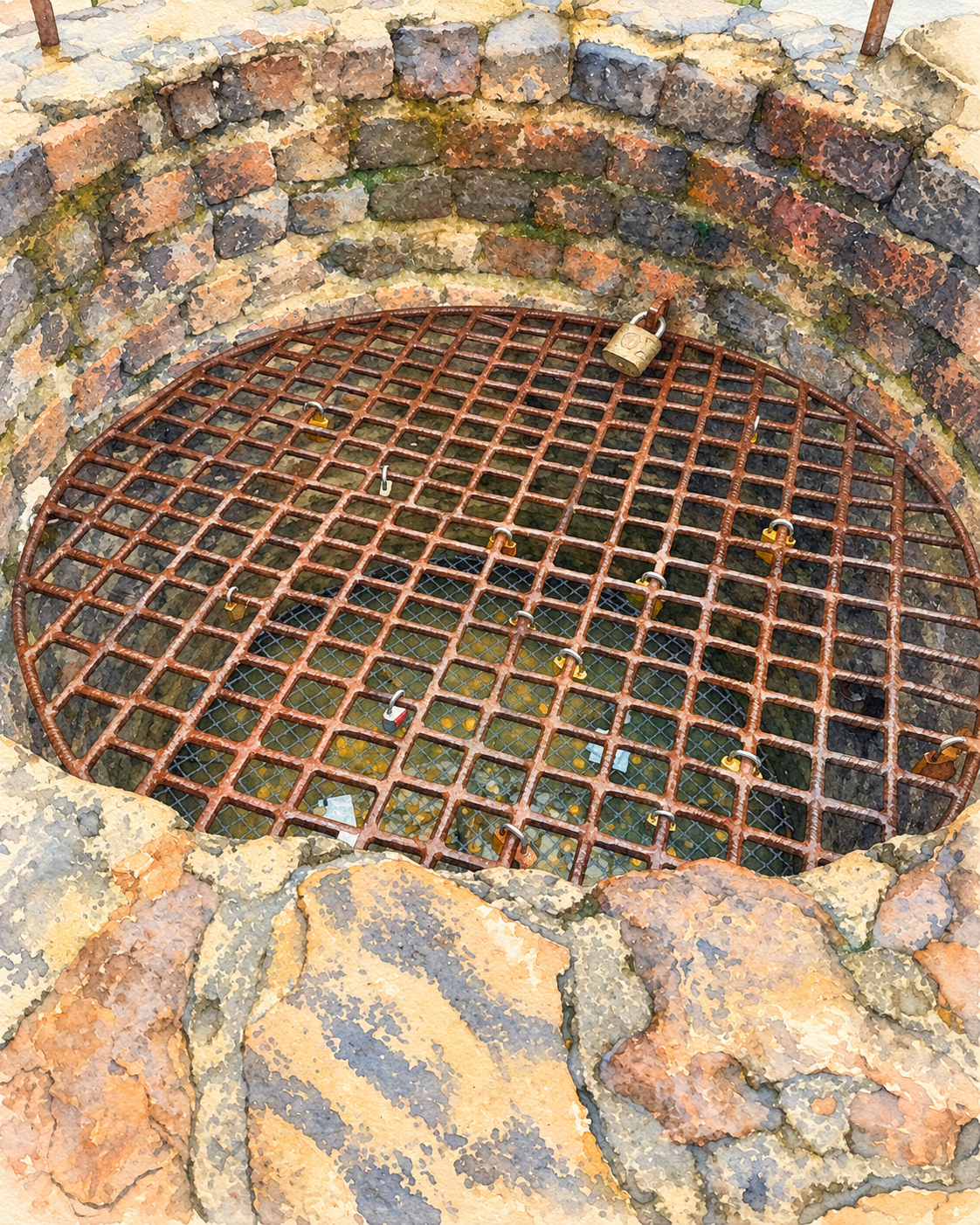
Later, as we began walking toward the cable car that would take us back down the mountain, we passed a wishing well.
I had noticed it earlier, but this time we stopped.
Adan’s parents began handing out coins so everyone could make a wish.
And standing there on top of that mountain, I knew immediately what mine would be.
I did not wish for myself.
I wished for my husband.
I wished for everything to work out for him.
For him to get what he wanted from life.
For the things he worried about to resolve themselves.
For his dreams to come true.
There is supposedly a rule that you are not supposed to tell people what you wish for, but I think we are far enough past the wishing well now that I am willing to take the risk.
The wish was for him.
Because standing there surrounded by his family, in the country he loved and could not be in with me, I felt him everywhere.
This trip had started because I wanted to meet these people. Because he could not simply get on the plane and come with me, I wanted to go toward the people and places he missed.
But on Monserrate, something deeper began happening.
I missed him.
Not simply in the ordinary way you miss someone when you travel without them.
I felt connected to him differently.
Our relationship had moved incredibly quickly. We had known almost immediately that we wanted one another. We had married forty-six days after meeting. There had been very little hesitation anywhere along the way.
But ours was still a young relationship.
And standing at that wishing well, somehow thousands of miles from him and surrounded by the people who had made him who he was, I felt this quiet certainty:
I know you.
I love you.
I know what matters to you.
This is for you.
I dropped the coin.
Then we headed toward the cable car.
The ride down was almost impossibly beautiful. Glass surrounded us, and Bogotá spread beneath the mountain while we descended through the mist. The city seemed endless.
I took photographs.
They took photographs of me.
Of course they did.
But when I look at those pictures now, what strikes me most is not Monserrate.
It isn’t the church.
It isn’t the city stretched below us, or the mist, or even the fact that I was finally standing in a place I had heard about for months.
It’s my face.
I look at myself in those photographs and think:
Oh my God.
I was so freaking happy.
Four Thousand Miles Away, Still in Charge
There was something about this trip I had not fully understood before I arrived in Colombia.
My husband had apparently planned half of it from Arizona.
I knew he had helped make arrangements. Of course he had. He had found our driver, talked with his family about where I would stay, and made sure everyone knew when I was arriving. But once I was actually there, I began to understand the scale of the operation. Adan was talking to the driver, talking to his father, talking to his mother, making introductions, arranging meetings, telling people where we needed to go. Occasionally he would mention something to me so casually that I assumed it was merely a suggestion, only to discover twelve hours later that an entire experience had somehow materialized around it.
I was four thousand miles away from my husband, and somehow he was still directing traffic.
Which is how, after spending a dreamy, misty morning on top of Monserrate eating changua and getting bracelets blessed inside a Catholic church, I found myself walking into a mostly empty office building in Bogotá to meet a private emerald dealer.
As one does.
Before we even made it inside, however, Colombia briefly tested my judgment.
There was a man standing outside wearing a Chicago Bears jacket.
Now, I am from Chicago. There are certain instincts that become deeply embedded in you, and apparently one of mine is that if I encounter Chicago Bears merchandise in an unexpected country, I must immediately acknowledge the person wearing it. My first instinct was essentially, Oh my God! The Bears! and to walk directly toward this complete stranger on a Bogotá street, presumably with my phone in my hand, ready to discuss football.
Adan’s family, who possessed considerably better survival instincts than I did, communicated some version of: Absolutely not. Please do not wander up to random men on the streets of Bogotá because you recognize their football jacket.
Fine.
I allowed myself to be redirected toward the building.
We stepped inside, took an elevator upstairs, and emerged into a long, quiet hallway that seemed almost entirely empty. The farther we walked, the more convinced I became that either we had the wrong floor or this was the beginning of a story in which the American woman should have paid considerably more attention to her surroundings. There were offices, closed doors, silence. We kept walking until, from somewhere near the very end of the hallway, we heard a voice.
“¡Hola!”
Around the corner came one of the largest men I had ever seen.
He also had an enormous smile, so apparently we were fine.
He greeted everyone warmly and led us into his office.
And then I saw the emeralds.
They were everywhere. Loose emeralds. Cases of emeralds. Emeralds spread across desks and arranged in little containers. Different shapes, different shades, different sizes. Stones that looked almost blue-green and others that seemed impossibly saturated, the kind of green that makes you understand immediately why Colombian emeralds have been coveted for centuries.
I had spent the previous afternoon responding politely to the emerald photographs Adan kept sending me from Arizona. Now I understood what he had been doing.
Of course we called him immediately.
And there we were: Luis Fernando, his mother, Mafe, the kids, the emerald dealer, me, and my husband four thousand miles away in Arizona, appearing once again inside a phone screen as though being physically absent from Colombia were merely an inconvenient technicality he intended to work around.
We began looking at stones. So many stones. One would be placed in front of me, then another. Someone would hold one up to the light. Adan would want to see it closer to the camera. His father would examine it. His mother would have an opinion. Mafe would look. I would compare two stones and then immediately forget which one I had preferred because now there were three more sitting in front of me.
It became a family activity.
Eventually, among all those emeralds, I saw mine.
A pear-shaped Colombian emerald.
There are colors that are difficult to explain because calling them simply green feels inadequate. This one reminded me of the sea I had seen only a couple of months earlier - the deep, shifting green-blue of Caribbean water beneath a stormy sky.
I loved it immediately.
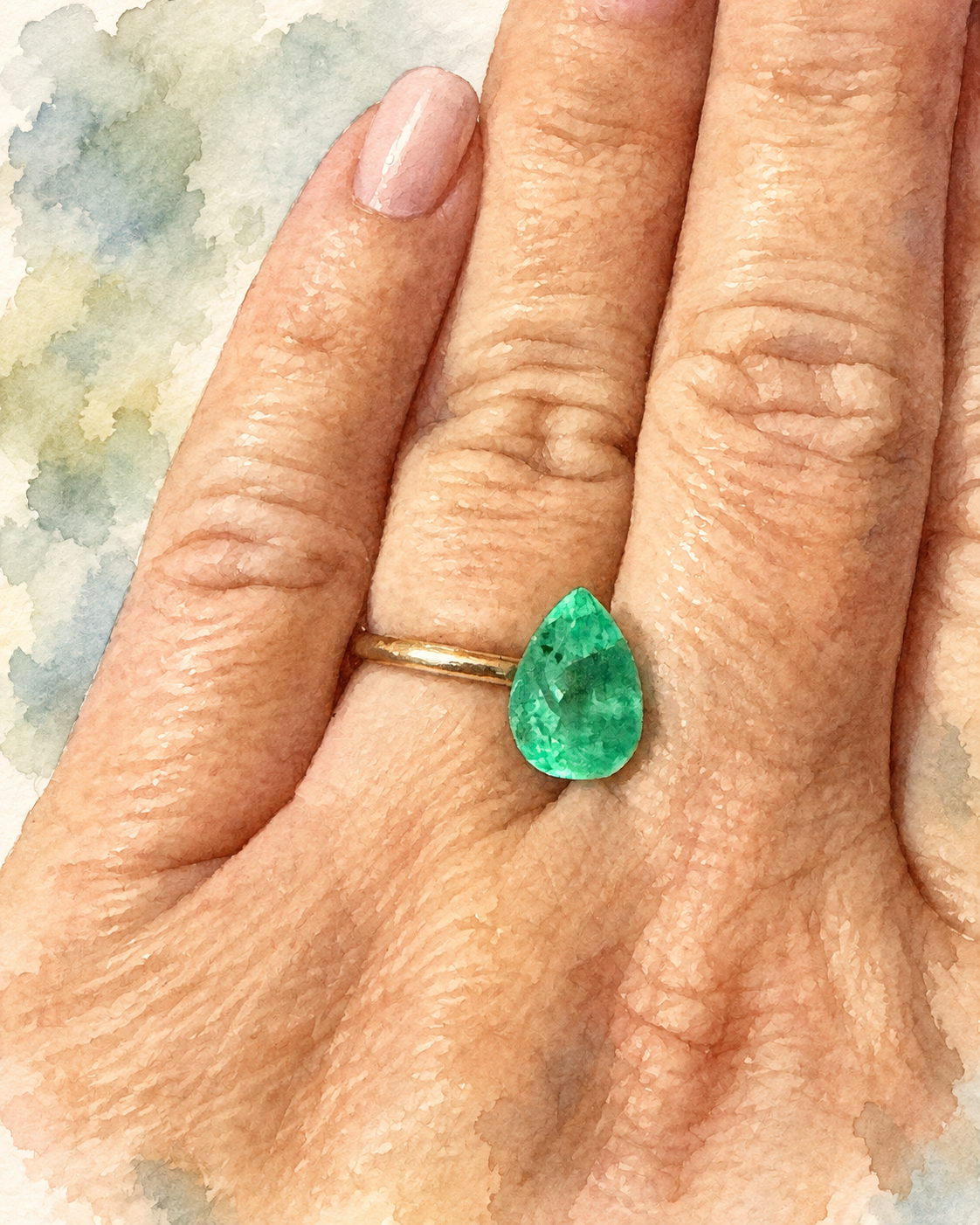
We chose another emerald too, and eventually four smaller stones that would become part of the plan for Adan’s wedding ring. There was something wonderfully ridiculous about all of us sitting there choosing them together. My husband and I had been married for only weeks. I had arrived in Colombia less than twenty-four hours earlier. His family and I had barely had time to establish a shared vocabulary beyond Google Translate, enthusiastic facial expressions, and food.
And yet here we were, collectively evaluating emeralds for our wedding jewelry like this was an entirely normal family Saturday.
The dealer kept the stones because they still needed to be certified. Luis Fernando would return a few days later to collect them, along with their certificates, before I left Bogotá. Then, just like that, the emerald appointment was over. We walked back down the long hallway, got into the elevator, and returned to the city.
I remember thinking about the absurd sequence of events that had already made up my day: waking up in Bogotá, riding a funicular into the clouds, eating changua on top of a mountain, listening to Mass through the mist, having Colombian bracelets blessed by a priest, making a wish for my husband, riding a cable car above the city, and then meeting a private emerald dealer and choosing Colombian emeralds with my husband and his family.
Perfectly normal Saturday.
Whose life was this?
And, increasingly, who exactly was the man I had married?
Because I was beginning to understand that Adan had not merely sent me to Colombia with a list of places I might enjoy. He had been quietly building an experience for me. He knew what he wanted me to see, who he wanted me to meet, and which pieces of Colombia he wanted to place in my hands. Somehow, from Arizona, he was still walking me through his world.
I thought I already knew my husband.
The next few days were going to show me how much more there was to know.
Yes. This is already very strong. I would not reinvent it; I’d preserve the comedy, the necklace hunt, Charger Gate, and especially the emotional turn once you’re back in Luis Fernando’s room. The main work is exactly what you said: smooth the rhythm, make the transitions more literary, reduce some of the stacked one-line paragraphs, and let the ending breathe. I also corrected the old FaceTime reference to WhatsApp/video calls.
The Gold Necklace Mission
The emeralds may have been the glamorous mission of the day, but they were not the only mission.
There was also the necklace.
From almost the moment I booked my trip, Adan had been talking about wanting me to bring him home a gold necklace from Colombia. Not just any necklace. He wanted a Colombian gold necklace. Somewhere along the way, this had become one of those little promises between us: I was going to Colombia, and I was coming home with a necklace for my husband.
Conveniently, we were already in one of Bogotá’s main jewelry districts. Even more conveniently, our emerald dealer personally walked us to a jewelry store.
Perfect, I thought.
This should be easy.
We walked in. They showed me a necklace. I liked it. Then they told me the price.
Something like eighteen hundred U.S. dollars.
I remember sitting there thinking, Okay. Either I have profoundly misunderstood the price of gold in Colombia, or I have just been assessed the American tax.
Because absolutely the fuck not.
I loved my husband very much. I did not love him eighteen-hundred-dollar-necklace-from-the-first-store-we-walked-into much.
So we thanked them and left.
And that is how the actual Gold Necklace Mission began.
We started wandering through Bogotá’s jewelry district, going from store to store, looking into windows and asking prices. There was gold everywhere—necklaces, bracelets, rings, chains, entire windows glittering with it—and every time something caught our attention, we went inside.
How much is this one?
No.
What about this one?
Also no.
Thank you very much.
Next store.
For a while, honestly, it was fun. We weren’t rushing. We were simply walking around Bogotá together, looking at jewelry and taking pictures, with Adan following the entire operation from Arizona.
At some point we stopped at a little café and had the most amazing coffee and pastry. I ordered an aromática, one of those warm Colombian fruit-and-herb drinks that I fell completely in love with, and for a while we just sat there.
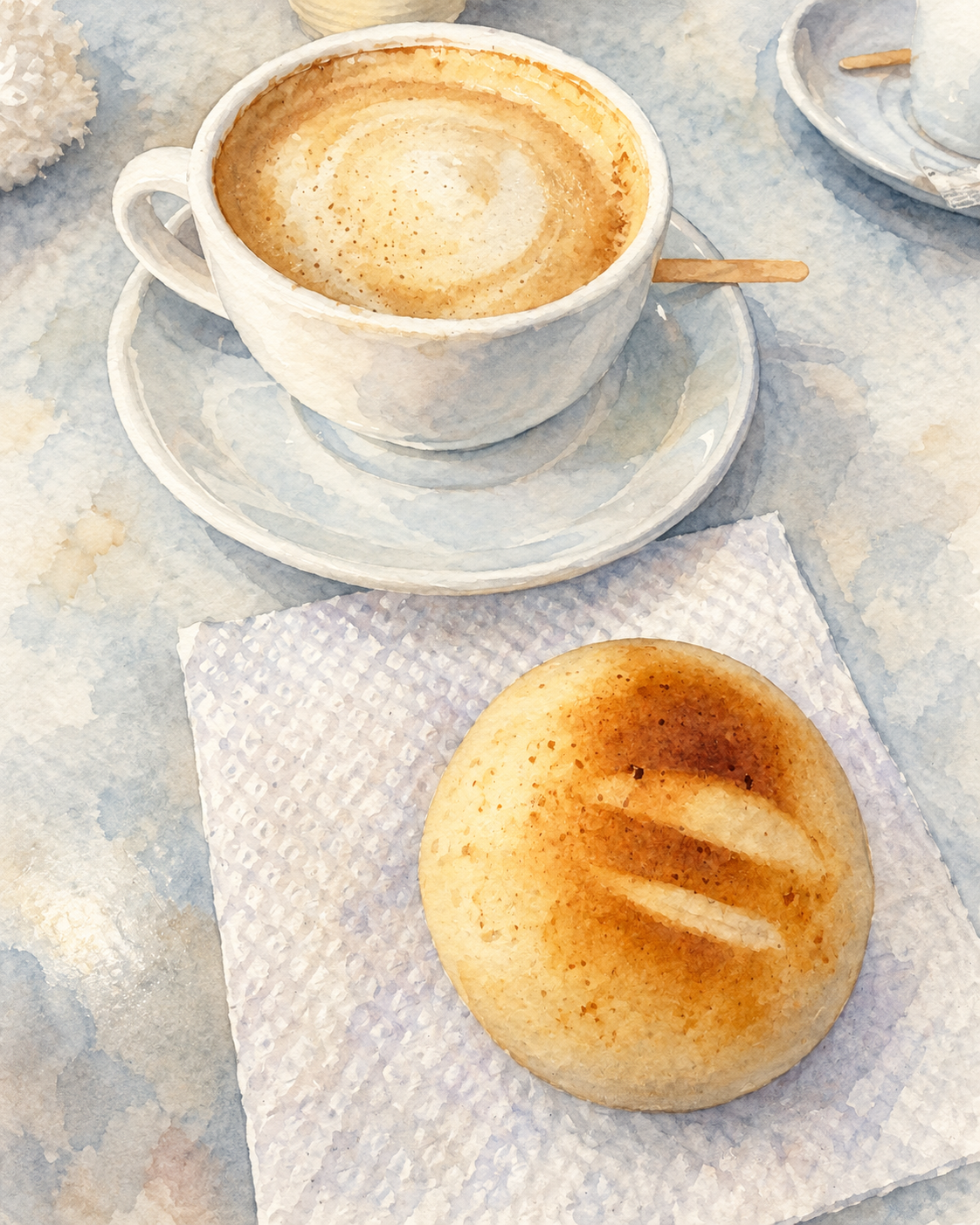
That is something I remember so fondly about that afternoon. We had specific things we were trying to accomplish, but the day never really felt like a checklist. We could stop. Have coffee. Eat something. Look around. Talk. Then get up and keep wandering.
And all the while, I was sending things to Adan.
Jewelry we were considering. Store windows. His favorite beer when I happened to see it. Random things he had told me about Colombia that suddenly meant something different because now I was seeing them with my own eyes.
By this point, my phone had become the invisible extra person traveling with us. Adan lived inside it for so much of the trip that I barely noticed how dependent I had become on the thing until I looked down and saw my battery percentage.
My phone was almost dead.
Normally, this would be annoying.
In Bogotá, my phone was my camera, my map, my translator, my connection to my husband, my ability to communicate with the people physically standing beside me, and approximately eighty-seven percent of my ability to function as an adult.
This was not a phone.
This was life support.
And yes, before I left Arizona, Adan had specifically told me to bring a portable charger.
And yes, I had listened.
Unfortunately, the night before I had discovered that there wasn’t an outlet close enough to Luis Fernando’s bed for me to keep my phone beside me while I slept, and obviously I wanted my phone beside me. So I had used the portable charger overnight.
Which meant the portable charger was now back at the apartment.
Charging.
Very useful.
Mafe immediately volunteered to find me another one. She disappeared into the shopping district while the rest of us continued looking around, and eventually she came back.
Without a charger.
Apparently they were too expensive.
Okay.
How expensive?
About thirty U.S. dollars.
Now, I need to be very clear about something: I adore Mafe. And the fact that she was absolutely determined not to let somebody overcharge me was incredibly sweet.
In retrospect.
At the time, I was staring at the battery percentage on my only reliable means of communication as it slowly ticked toward zero in the middle of Bogotá.
I did not care if the charger cost thirty dollars. I did not care if it cost fifty. At that particular moment, if someone had offered me a functioning portable charger in exchange for a minor internal organ, I probably would have asked which one they needed.
Please.
Buy.
The charger.
But Mafe was still looking.
Surely there was a better price somewhere.
I, meanwhile, was becoming increasingly frantic.
Eventually, in one of the more ridiculous examples of how thoroughly Adan continued to participate in this trip from Arizona, I used my rapidly dying phone to call my husband so that he could contact his sister, who was physically somewhere near me in Bogotá, and communicate the following essential message:
Buy my wife the charger. She does not care what it costs.
Apparently that was the authorization we needed.
A charger was purchased. My phone was plugged in. International crisis averted.
And then, because apparently my body felt the afternoon needed another subplot, I developed a headache.
So the Gold Necklace Mission expanded to include Advil and water.
We found both. I took the Advil, drank some water, watched my phone slowly return from the dead, and began feeling somewhat like a functioning human being again.
And somewhere in the middle of all of this—the coffee, the pastry, the aromática, the jewelry stores, the dying phone, the Great Portable Charger Negotiation of 2026, and the headache—it finally occurred to me that we were approaching the necklace search completely backward.
We kept walking into stores, finding necklaces we liked, and then asking what they cost.
Why?
Why weren’t we walking in and saying, This is what I want to spend. Show me what you have for that.
I explained my brilliant new strategy to Adan’s mother.
Her reaction was essentially: yes. Obviously. That makes considerably more sense.
So that became the new plan.
We started walking into stores with the budget first.
Anything in this range?
No?
Next.
Anything here?
No?
Next.
Until finally we entered one store where the man told us he didn’t have what I wanted.
But then he pointed us toward someone else.
That guy did.
And that guy turned out to be our guy.
He understood exactly what I was looking for. He pulled out a gold necklace that was actually within the budget and then, to show me how it looked on a person, put it on himself.
I took a picture and sent it to Arizona.
Adan, is this what you want?
Yes.
That was it.
After hours of wandering around Bogotá—after the eighteen-hundred-dollar necklace, the coffee, the aromática, the dying phone, the charger, the headache, and what felt like every jewelry counter in the city—there it was.
His necklace.
And I loved that I had found it this way.
I hadn’t walked into some polished jewelry store, pointed at something expensive and swiped a credit card. We had hunted for it. His family had hunted for it with me. One jeweler who couldn’t help us had sent us to another jeweler who could. And somewhere in Arizona, Adan had followed the entire ridiculous adventure through my phone.
I still have that jeweler’s card.
Because when we go back to Colombia together someday, we are going back to that guy.
And I love what that realization represented. I had gone to Colombia because I wanted to see my husband’s world. Yet somewhere in those first days, I was already discovering little places inside that world that I wanted to bring him back to myself.
And naturally, somewhere during this entire gold-shopping odyssey, I also managed to buy two necklaces for myself.
One of them is this gorgeous Italian gold necklace woven from yellow, white and rose gold. I love it so much that sometimes I almost wish I hadn’t bought the first necklace.
Almost.
Now I wear them layered together—two gold necklaces from Colombia, found during one long, ridiculous, wonderful afternoon wandering around Bogotá with my husband’s family while he followed along from Arizona.
So yes.
The mission was completed.
Adan got his Colombian gold necklace.
I somehow got two.
Everyone survived.
And my phone was fully charged.
Meanwhile, Back in Arizona
When we finally returned to Luis Fernando’s apartment, I went into the bedroom.
His bedroom.
Because Luis Fernando had given it to me for my stay and was sleeping on an air mattress in the living room.
That was something I was beginning to understand about this family. They didn’t simply tell me I was welcome. They physically rearranged themselves to make room for me.
I sat down on his bed and started spreading out the jewelry we had bought that afternoon. I tried on my necklaces, took pictures and sent them to Adan. After an entire day of Colombian food, Catholic churches, emeralds, gold, coffee, aromática and approximately one hundred WhatsApp messages, my husband sent me a picture from our home in Arizona of the dinner he had made for himself.
Steak.
Mustard.
A can of Coke.
And for some reason, that picture stopped me.
I had been moving so quickly through Bogotá that I hadn’t really had time to consider what this trip looked like from the other side of the phone.
While I was racing through his country having this enormous adventure, my husband was at home watching it happen from four thousand miles away.
These were his people.
This was his country.
These were streets he knew, foods he loved, sounds and places and little pieces of a life that had existed long before there was an us.
And I was there.
Without him.
For the first time, I really let myself wonder what that must have felt like.
What was it like for him to watch me sitting beside his parents? To see photographs of me wearing the purse his father had bought me on Monserrate? To watch his mother feed me and see me laughing with Mafe? What was it like to help me choose our emeralds through the screen of a phone while his entire family sat around the table with me?
Was he happy?
Homesick?
Did it hurt a little?
Probably all three.
And suddenly, sitting there on his father’s bed with Colombian jewelry spread around me, I felt overwhelmed with gratitude.
Gratitude that I got to make this trip at all. Gratitude that Adan trusted me enough to send me into this part of his life without him. Gratitude for the family that had opened its arms to me the second I walked through those airport doors. Gratitude for Luis Fernando sleeping on an air mattress so I could have his room. Gratitude for Mafe arguing over the price of a charger because she was determined not to let anyone take advantage of me.
And gratitude for my husband, sitting at home in Arizona eating steak with mustard and Coke while somehow still managing to orchestrate an extraordinary day for me four thousand miles away.
I had loved him when I got on the plane.
Of course I had.
But sitting there in the middle of his father’s home, surrounded by all these little pieces of my husband’s world, I realized something had changed anyway.
I loved him more deeply than I had when I left.
Not because I had discovered some different version of him.
Because I was beginning to see more of him.
The people who loved him.
The places he carried with him.
The foods that tasted like home.
The way his family made room.
The things he wanted to give me even when he couldn’t physically be there to hand them to me himself.
And the strange thing was, I still hadn’t reached the place he most wanted me to see.
The next morning, we were going to Saldaña.
I didn’t know it yet, but Bogotá had only been the introduction.
I was about to go deeper into his world.
♥️
