I Went to Colombia (Part Two)
On the Other Side of the Glass
Landing in Bogotá was almost suspiciously easy.
After everything I had built up in my mind - international arrival, immigration, customs, doing all of this alone - the plane landed, taxied to the gate, and suddenly I was just...there.
Getting through immigration was surprisingly painless once I figured out where I was supposed to go. That last part took a minute. English signage at the Bogotá airport was not nearly as plentiful as my optimistic American self had apparently anticipated, and I spent some time doing that particular kind of international-travel wandering where you are trying very hard to look like you know exactly what you are doing while quietly searching every sign for a word you recognize.
Eventually, I found the right line. Passport presented. Questions answered. Stamp acquired. Colombia officially let me in.
Then I headed toward baggage claim, where the universe apparently decided things had been going a little too smoothly.
The carousel started.
Stopped.
Started again.
Stopped again.
Excellent.
While I waited, I was simultaneously trying to connect to airport Wi-Fi, cellular data, international service, divine intervention… basically anything that would allow my phone to work. I needed to message Adan. I needed to find his family. I needed to know where they were waiting and how, exactly, I was supposed to locate a group of people I had never actually stood in the same room with.
Finally, I connected to the free 30 minutes of airport WiFi. A message instantly popped up from his mother. A photograph of me taken through the glass.
They could see me.
I cannot adequately explain what that did to me.
For months, I had known these people inside a rectangle on my phone. I knew their faces and their voices. I recognized the rooms behind them. I knew the particular chaos of their family video calls, the way several people might be speaking at once while Adan tried to translate something for me and I smiled along, hoping I had correctly identified whether we were discussing dinner or somebody’s medical problem.
They weren’t strangers.
But screens flatten people in ways you don’t realize until suddenly they don’t.
Seeing someone on WhatsApp does absolutely nothing to prepare you for discovering that they are standing ten feet away from you on the other side of a pane of glass.
Looking at you.
Waiting for you.
And somehow already excited enough about your arrival to be taking pictures before you have even collected your suitcase.
Suddenly, the baggage carousel could not move fast enough.
When my suitcase finally appeared, I grabbed it and made my way through customs as quickly as I could. I remember pushing everything toward those final doors with this growing awareness that the people on the other side were no longer going to be people inside my husband’s phone.
They were going to be real.
And then the doors opened.
There they were.
His mother.
His father.
His sister.
Flowers. Balloons. A sign.
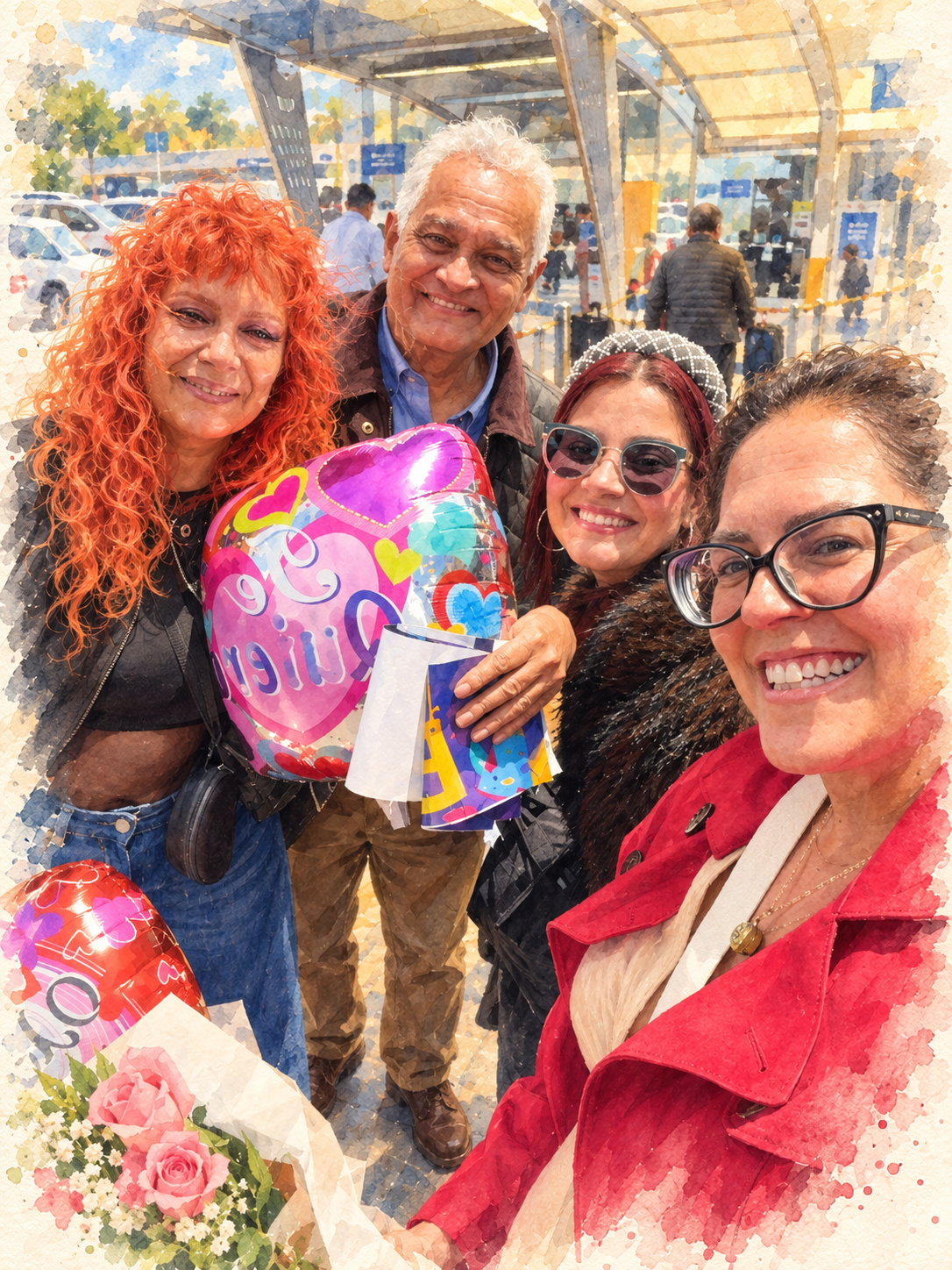
Arms around me. Kisses, hugs, “Dios Mio” being thrown around everywhere.
There was no cautious first meeting. No awkward little pause where everyone stood around deciding what to do in this particular situation. No formal introductions that made any sense whatsoever after months of already appearing in one another’s lives.
They just took me in.
It felt less like meeting people for the first time and more like finally arriving somewhere I had already been expected.
Of course, almost immediately, we called Adan.
And suddenly the entire geometry of our lives had reversed.
For months, Adan and I had sat together in our home, our car, pretty much everywhere we went while his family appeared inside a phone. His mother’s face would fill the screen. His father would lean into the frame. His sister and the kids would appear and disappear. Colombia would arrive in Arizona through WhatsApp, one little rectangle at a time.
Now I was standing in Bogotá surrounded by all of them.
And Adan was the one inside the phone.
I completely lost it.
I cried harder than I had cried in a very long time, which was impressive considering I had already been emotionally unstable for approximately the entire journey since leaving my husband at the Phoenix airport the night before.
I kept telling him the same things.
“I’m here.”
“I’m safe.”
“I’m with everybody.”
“I’m here.”
I think part of me was telling him.
And part of me was still trying to convince myself.
Because I really was.
I had crossed the airport alone. Found immigration. Retrieved the suitcase. Made it through customs. Navigated a country I had never visited in a language I barely spoke.
And on the other side of those doors was my family.
Somehow, amid the flowers and balloons and luggage and tears and phones and people talking in two languages, we eventually organized ourselves enough to leave the airport.
I don’t remember the logistics particularly well. I remember the feeling.
The suitcase got loaded.
People got into the car.
I got folded into the middle of all of it.
And then, almost before I had fully caught up with what had just happened, we pulled away from El Dorado and headed into Bogotá toward Luis Fernando’s home.
I sat there looking around at these people I had known for months and had only just touched for the first time.
Colombia was no longer beneath an airplane wing.
It was outside the car windows.
And I was inside it.
Colombian Hospitality Lesson One: You Are Hungry
We met the driver Adan had arranged and headed toward his father’s apartment, where I learned almost immediately that Colombian hospitality apparently has one central operating principle:
You are hungry.
It does not matter whether you are actually hungry. It does not matter whether you have just eaten. It does not matter whether you have consumed enough food in the previous twelve hours to sustain a minor sports team. Someone is going to ask you if you are hungry, and if you say no, there is a strong possibility they will simply conclude that you misunderstood the question.
So, almost immediately, we went looking for food.
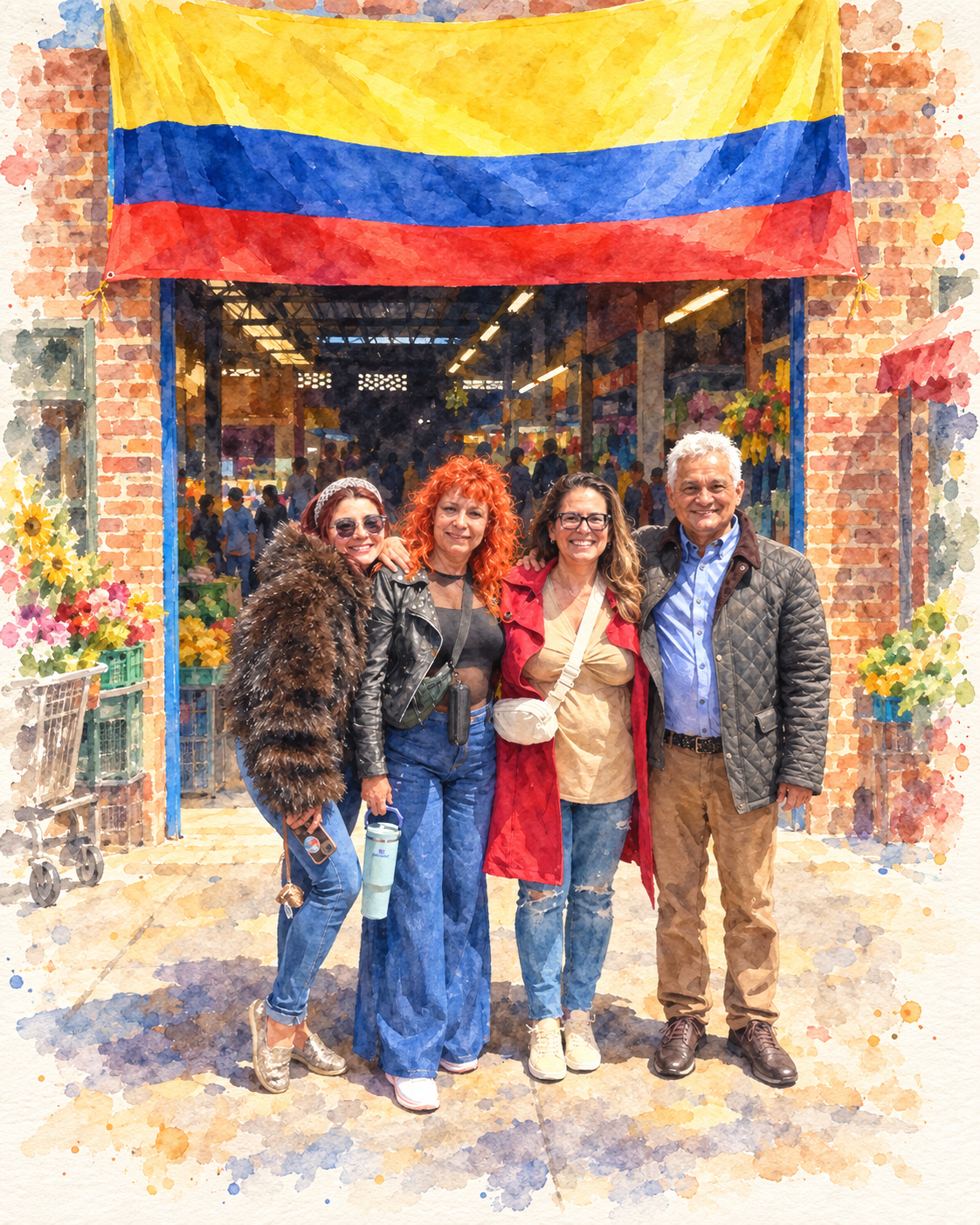
We walked to a nearby market, and suddenly I was surrounded by some of the most beautiful fruit I had ever seen. Not tasteful little grocery-store arrangements with six perfectly spaced strawberries under flattering lighting. This was fruit in abundance. Piles of it. Mountains of strawberries. Colors everywhere. Things I recognized, things I didn’t, everything looking brighter and more alive than produce had any reasonable need to look.
We stopped at a little café, where I was given pastries and juice while all of us began figuring out what communication between us was actually going to look like.
The answer, apparently, was: whatever worked.
Google Translate. Gestures. Pointing. A few words of Spanish from me, a few words of English from them. Smiling. Nodding. Facial expressions. Occasionally staring at one another for several seconds before everyone started laughing because absolutely nobody knew what had just happened.
And somehow, it worked.
That was one of the first things Colombia began teaching me. Communication did not have to be elegant to be intimate. We did not need perfect sentences to enjoy one another. We just needed enough patience to keep trying and enough humor to find it funny when we failed.
When we got back to the apartment, Luis Fernando had gone to pick up the kids from school.
Until then, Samuel and Antonella had still belonged to that same strange category as everyone else in Adan’’s family: people I knew well enough to recognize instantly, even though I had never actually stood in the same room with them.
Then the door opened and there they were.
I don’t have nieces or nephews of my own, so I don’t think I understood before meeting them what a gift this part of marrying Adan would become for me. We met later in life, with children and whole histories of our own already behind us. We weren’t building our relationship around the idea of starting another family from the beginning.
But suddenly I had these two children in my life who were incredibly important to the man I loved.
And they became incredibly important to me too.
Antonella attached herself to me almost immediately.
She was spirited and affectionate and completely herself - one of those children whose presence fills the space around her. There was very little hesitation in her. I had barely arrived, and somehow she seemed to have already accepted the situation: apparently I belonged here, and therefore I belonged to her too.
Samuel was different, quieter and impossibly sweet.
And I could not stop looking at him.
There was so much of Adan in him.
Not simply a family resemblance, although there was certainly that. There was something about his face, his expressions, the way he carried himself that made me feel as though I had been handed this tiny glimpse of the little boy my husband might once have been.
I had known Adan only as an adult. I knew the man who lived with me in Arizona, the man who drove me to the airport, the man who called his mother several times a day and somehow continued directing my Colombian adventure from four thousand miles away.
Now this adorable little boy was standing in front of me, and something about him made another piece of Adan’s world feel suddenly tangible.
The children are enormously important to him. I already knew that. He calls them, talks to them, checks on them, guides them. He takes being their uncle seriously. And watching them together through WhatsApp had already shown me a gentler, protective part of him that I loved.
Meeting them made that part of him real in a completely different way.
Samuel was also learning English at school, which immediately made him one of my most valuable allies in Colombia.
Every so often he would understand something or offer a word in English, and I thought it was the cutest thing in the world. Between Samuel’s school English, my extremely questionable Spanish, Google Translate, and the general family strategy of gesturing enthusiastically until everyone understood one another, communication somehow continued.
Both of the kids were so polite and generous. They shared things. They included me. They never made me feel like some unfamiliar adult who had suddenly appeared inside their family.
And once again, I had that strange sensation that had followed me since I walked through the airport doors: I had just met them, but somehow it did not feel like the beginning.
I realized then that I had already become Tía Molly before I ever arrived.
There wasn’t much time to sit with that feeling before Luis Fernando revealed what else he had brought home.
A tres leches cake.
Because apparently picking up two children from school was not enough of an errand. He also needed to make sure I had dessert.
At this point, I had already been fed pastries and juice, walked through a market overflowing with fruit, and eaten enough in the previous twelve hours to sustain a small athletic team. Clearly, what I needed next was cake.
I was, however, beginning to understand the system.
You arrive.
They feed you.
You insist you are full.
They feed you something else.
The cake was delicious, even though by that point I was fairly certain my stomach had reached maximum legal occupancy. I sat there eating it while Adan’s mother began showing me photographs of him as a little boy.
A few days earlier, she had been at his grandmother’s house and had taken pictures of old family photographs so she could show them to me.
There was something about that moment that landed quietly.
I had been in Colombia for only a few hours, and already I was sitting inside his father’s home eating tres leches cake while his mother showed me pictures of the man I loved before I had ever known him.
Little Adan.
Different ages. Different moments. A life that had existed long before Arizona, long before Facebook Dating, long before either of us had any idea the other person existed.
I looked at those photographs with the strange tenderness that comes from loving an adult and suddenly being given access to the child he once was.
And nobody treated me like a guest who needed to earn her place at the table.
I was just there.
I was being fed. Asked if I needed anything. Asked if I wanted something to drink. Told to sit down. Told not to worry about things. Every time I even considered doing something for myself, someone seemed prepared to intercept me and do it first.
This should probably have made me uncomfortable.
I am exceptionally independent. I am accustomed to handling things myself, taking care of myself, figuring out what needs to be done and doing it. I have spent a very large portion of my adult life operating that way.
And yet, to my own surprise, I did not fight them on it.
I let them take care of me.
I let myself sit there and eat the cake.
I let someone bring me something instead of immediately getting up to get it myself.
I let myself be fussed over.
And I liked it.
There was something almost disarming about being cared for so naturally that nobody seemed to consider whether I needed permission to receive it.
All afternoon, Adan kept appearing.
At first, I assumed we would check in every few hours. Maybe I would call him once I was settled. Maybe we would talk at night and I would tell him everything that had happened.
That is not remotely what happened.
He called his father.
Then his mother.
Then somebody else.
Then I would look across the apartment and discover that his sister was talking to him. A few minutes later one of the kids would have the phone, talking to him or carrying him around the room. The call would end, and before long he would somehow appear again on somebody else’s screen.
At some point I realized something that would become one of the defining features of the entire trip:
Adan was not waiting at home in Arizona for me to tell him about Colombia.
He was on the trip.
He just happened to be traveling through everybody’s phones.
He moved through the apartment from person to person, call to call, sometimes talking to me and sometimes talking to them, occasionally seeming to exist in several conversations at once. Thousands of miles away, he was still woven directly into everything happening around me.
And meanwhile, while I was trying to learn everyone’s rhythms, communicate in Spanish, eat the food being placed in front of me, and understand how I had somehow become completely absorbed into this family within approximately three hours of landing, my husband had begun texting me pictures of emeralds.
Emeralds.
Beautiful ones.
Lots of them.
At the time, I did not entirely understand why.
Yes, I knew Colombian emeralds were famous. I knew they were considered some of the finest in the world. I understood that this was A Thing Colombia was known for.
So every time another photograph appeared on my phone, my response was essentially:
Yes, babe. Very pretty.
Beautiful emerald.
Love that for Colombia.
Perhaps tomorrow, when we go shopping, I will look at some.
At that moment, however, I had considerably more immediate concerns. I had a cake to finish, several people to understand, an entire country to absorb, and dinner later that evening.
I had absolutely no idea that those emerald photographs were not random at all.
But that part of the story was still waiting for me.
For the moment, I did the most sensible thing I had done all day.
I took a nap.
And somehow, we were only halfway through my first day in Colombia.
Matching Shoes
That evening, we had dinner reservations at a rooftop restaurant in Bogotá that I had chosen very carefully from Arizona.
I had done what I tend to do when something matters to me: research. A lot of research.
This wasn’t just going to be my first dinner in Colombia. It would be my first real dinner with Adan’s family, and I wanted it to feel special. His parents would be there. Mafe would be there with Samuel and Antonella. And two of my coworkers, who both lived in Bogotá, were meeting us too.
That part meant more to me than I had expected.
My job had three people based in Colombia, two of them in Bogotá, and before I ever booked the trip I had loved the idea of bringing these completely separate parts of my life together. My coworkers knew me in one context. Adan’s family knew me in another. And somehow, on my first night in a country I had never visited before, all of these people were going to sit around the same table.
Before dinner, though, there were presents.
That enormous suitcase I had dragged through two airports and waited impatiently for at baggage claim finally got to fulfill its purpose.
We opened it up and started giving everyone the things Adan and I had spent weeks choosing. The gifts for his parents. The things for Mafe and the kids. All those little decisions we had made together back in Arizona were suddenly becoming real objects in the hands of the people we had bought them for.
And, of course, Adan was there for it through video.
He couldn’t physically hand his family the gifts himself, but he could watch them open them. He could see their reactions. He could talk to them. He could see the things we had picked together finally arrive where they were supposed to go.
One of those gifts was a pair of shoes for his mother.
And another matching pair for Mafe.
I had the same shoes.
So naturally, on the very first night I had ever physically met my mother-in-law and sister-in-law, the three of us put on our matching shoes and wore them to dinner.
There is a photograph of our feet together that I absolutely love.
At the time, it was simply cute.
Looking at it now, I think it says much more than I understood then.
There had been remarkably little of the awkwardness one might expect from this situation. No prolonged stage of Hello, I’m the American woman who married your son forty-six days after meeting him. I hope everyone is comfortable with this.
Apparently we had skipped that part.
We went directly to matching shoes.
By the time we arrived at the restaurant, I had been traveling or awake for what felt like approximately seventeen years. I had crossed an international border, navigated immigration and customs, met my husband’s family in physical form for the first time, eaten pastries and fruit and tres leches cake, opened presents, cried repeatedly, communicated in two languages, and taken one very necessary nap.
Now I was going to dinner.
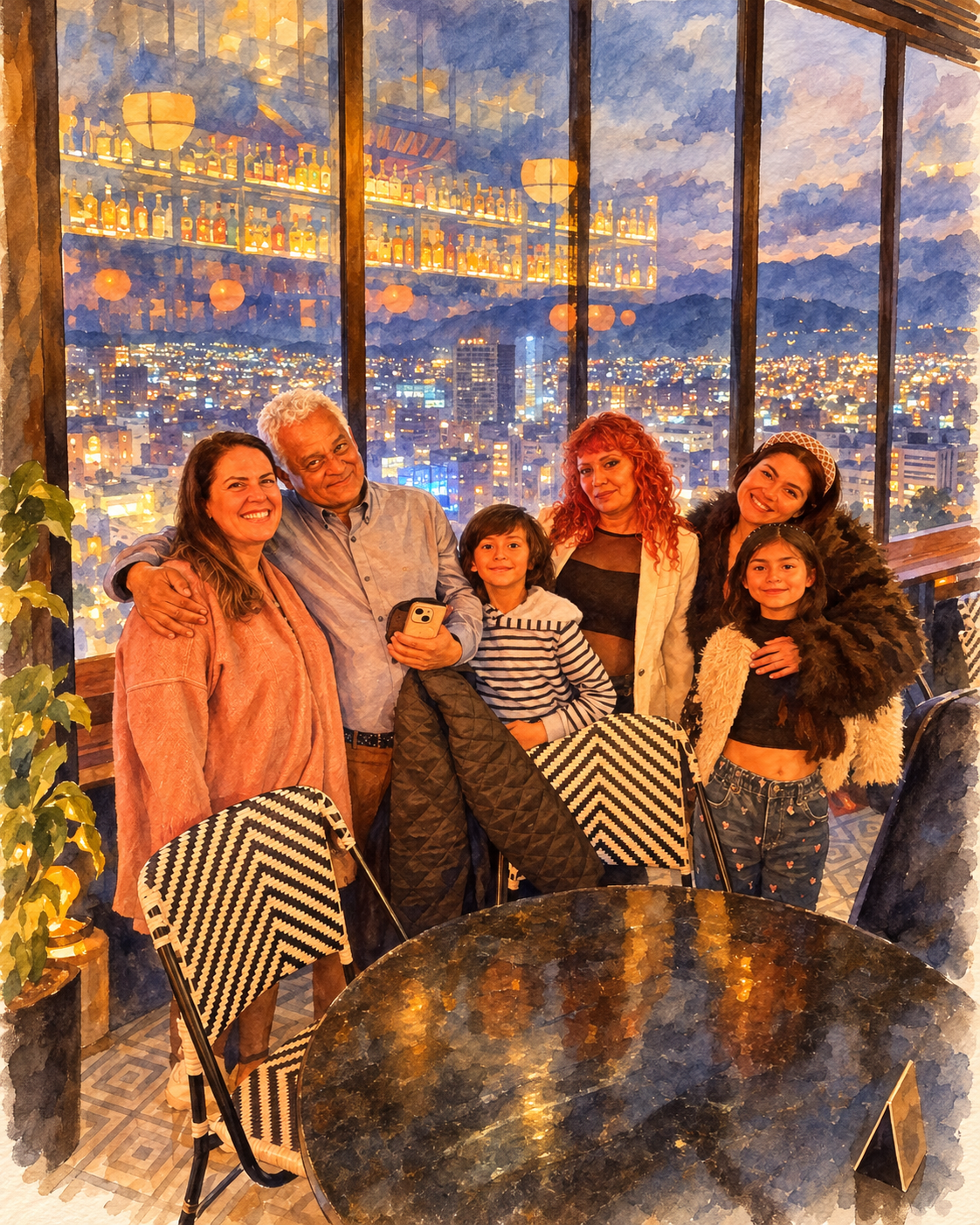
The restaurant was beautiful. From the rooftop, Bogotá stretched out around us, and as the evening went on we caught some of the sunset over the city. The food was wonderful, but what I remember even more clearly is looking around the table and thinking about how strange and lovely it was that everyone was there.
My coworkers slipped into the evening almost effortlessly. Both of them spoke English and Spanish fluently, something I had known intellectually but had not fully appreciated until that dinner. Suddenly I had two people sitting beside me who could move freely between both sides of the table.
They translated.
They filled in gaps.
They explained things.
At one point, one of them essentially took over ordering with the server, which may have been one of the greatest gifts anyone could have given me at that particular moment.
By then, my brain was done.
I had reached the stage of exhaustion where even perfectly straightforward decisions had begun to feel suspiciously complicated. Trying to navigate a menu in Spanish might actually have finished me off.
So I let them help.
And once again, I found myself doing something that did not always come naturally to me:
letting people take care of me.
We ate. We laughed. We took pictures. Conversations moved back and forth across the table in English and Spanish, sometimes translated and sometimes not. Adan appeared through the phone, of course, still somehow managing to be part of an evening happening thousands of miles away from him.
At some point I looked around and realized that these people who had belonged to entirely different categories of my life only hours earlier were simply sitting together.
My coworkers were meeting the family I had traveled all the way to Colombia to know.
My husband’s family was meeting people from my life.
Bogotá was glowing around us.
And somehow it all fit.
The moment I remember most clearly, though, happened after dinner.
Everyone was finishing up, going to the restroom, gathering things and slowly making their way toward leaving. I ended up sitting on a small bench outside the restaurant with Luis Fernando.
Just the two of us.
There was no translator sitting beside us.
He spoke essentially no English, and whatever Spanish I had managed to access throughout the day had apparently decided it was finished working too.
So we didn’t really talk.
We hugged.
And then we just stayed that way.
I have a picture from that moment that I treasure. I’m sitting beside my husband’s father, tucked into him, both of us smiling, and even now I can remember how it felt.
Something inside me softened.
Luis Fernando had played an enormous role in the life of the man I loved. He had known Adan before I did, before Arizona, before the life we were building together. He had helped shape the person who would eventually become my husband.
And now he was sitting beside me, holding me as though accepting me required no complicated evaluation at all.
His son had chosen me.
That mattered to him.
And somehow, that was enough for him to begin with love.
There was something deeply healing about that.
I didn’t need to explain myself to him. I didn’t need to prove that I deserved to be there. We couldn’t even have had that conversation if we wanted to.
There were no words available to us.
And none were necessary.
We simply sat there with our arms around each other, neither of us particularly eager to let go.
I had known this man through a screen. I had read the messages he sent me after our wedding, telling me that Fabricio had gained a wife and he had gained a daughter. He had told me before I ever arrived that his home was small in size but very big in love.
Now I was sitting beside him in Bogotá, feeling exactly what he had meant.
By the time we finally returned to the apartment, I was completely finished. Luis Fernando had given me his room while I stayed with the family, another kindness I was rapidly becoming incapable of protesting, and I collapsed into bed.
My first day in Colombia had somehow contained enough emotion, food, people, languages, phone calls, gifts, photographs and love to fill an entire week.
I fell asleep almost immediately.
Which was unfortunate.
Because Colombia had apparently scheduled my wake-up call for approximately six o’clock the next morning.
♥️
