I Went to Colombia (Part Seven)

One Last Day
Tuesday belonged partly to Colombia and partly, annoyingly, to my job.
I had known that was going to happen. This wasn’t technically a vacation, and I had arranged to spend part of the day working with my coworker who - somewhat hilariously - was based in Bogotá herself. We had a perfectly reasonable plan involving a shared office space, reliable Wi-Fi, desks and presumably all the other things associated with organized professional adults.
Naturally, that plan fell apart.
So I improvised.
I found a coffee shop, opened my laptop, took calls, answered messages and tried very hard to behave as though this were an ordinary Tuesday instead of my final full day in Colombia. When I needed to move, I packed everything up, found somewhere else and opened the laptop again.
There was something almost offensive about having to care about emails.
Outside the windows was Bogotá. My suitcase was packed. My Colombian emeralds were safely tucked away in my carry on. Five of Fabricio’s mother’s homemade arepas were waiting to travel four thousand miles home with me. And somehow I was supposed to concentrate on work.
My coworker was supposed to meet me around nine.
Nine became ten. Ten became eleven. By noon, I was stressed enough that the entire romantic idea of the two of us working side by side in Colombia had started to lose some of its charm.
And then she arrived.
Once we finally settled in, the day softened. We pulled out our laptops and actually worked together. She listened to some of my calls, and we talked about work in that strange shorthand that happens when someone finally gets to sit beside you and see what you actually do all day instead of experiencing it through Slack messages and meetings.
Later, we joined our marketing team call: sitting side by side in Bogotá while everyone else appeared in little rectangles on our screens from the United States.
That made me smile.
For months, Colombia had existed inside my phone.
Now I was the person inside everyone else’s screen.
We worked. We ate. We talked. I took calls. We drank coffee. And I was wearing this Bogotá outfit I absolutely loved, which mattered to me more than it probably should have. I had spent so much of the trip bundled against Bogotá rain, melting in Saldaña, crawling into bed exhausted or carrying enough electronics to operate a small command center that it felt nice to simply feel good in my clothes.

The whole day was simultaneously ordinary and surreal.
It was work. Coffee. Calls. Lunch.
And Bogotá outside the window.
Underneath all of it was one thought I could never quite push away:
Tonight I leave.
Eventually, I closed the laptop.
There was only one thing left to do.
Go back to my family and say goodbye.
One Last Dinner
Fabricio’s father suggested pizza.
A normal person might hear, “Let’s get pizza,” and simply say, Great.
I apparently heard it as an invitation to conduct restaurant research.
This is who I am.
Eventually, I found La Fabbrica near Parque de la 93, and it was perfect. It was a Tuesday night, so the restaurant wasn’t particularly crowded, and the space was beautiful without feeling formal: big windows, warm rooms, couches and chairs tucked into little sitting areas that made the whole place feel almost more like someone’s very stylish home than a restaurant.
There are places in Scottsdale where people literally pay admission to take photographs inside elaborately staged selfie rooms.
La Fabbrica was just naturally that.

Fabricio’s sister and niece understood this immediately.
We took pictures everywhere. On the couches. By the windows. In the little sitting areas. Outside. Pictures of the women, pictures of me, group pictures, pictures of everybody in different combinations.
By then, I understood that this was simply how Fabricio’s family loved a moment.
You took the picture.
And then you took another one.
Just in case.
Not because anyone was performing for social media or trying to prove anything. The photographs were the point because the memory mattered.
You were here.
Remember this.
Outside, the sun disappeared and Bogotá began to glow. Streetlights came on. The windows started reflecting the warm restaurant back at us, and Parque de la 93 was alive just beyond them on an ordinary Tuesday evening.
We ate Neapolitan pizza. We laughed. We took more pictures.
And for a little while, it felt wonderfully normal.
Just dinner with family.
Except, of course, it wasn’t.
Because every one of us knew what came next. I was leaving.
Before that happened, though, there were things I needed to say.
I had been thinking about this moment carefully. There was too much I wanted them to understand for me to trust that I could stumble my way through it in Spanish at the table, so I had prepared what I wanted to say in their language.
I wanted them to hear it that way.
Not translated by somebody else after the fact. Not reduced to whatever combination of English, gestures and Google Translate I could manage in the moment.
I wanted them to hear directly from me what these days had meant.
So I thanked them.
I thanked them for welcoming me into their family so completely and for loving me before they really knew me. I thanked them for trusting me with someone they loved so much and for raising, guiding and helping shape the wonderful man I got to call my husband.
More than anything, I wanted them to know that their son was loved.
That he was safe with me.
That I understood what a gift he was.
That I loved him enormously.
And that somewhere during these extraordinary days, I had fallen in love with them too.
There was another reason saying all of that mattered so much to me.
I have lost both of my parents. And one of the greatest gifts hidden inside those losses - if there can be such a thing - was that I had the opportunity to say goodbye to both of them. I was able to tell them the things I needed them to hear while they were still here to hear me.
I am not comparing leaving Colombia to losing someone. Those are not remotely the same thing.
But grief taught me something I have tried very hard not to forget: Say the important thing while you can.
Don’t save it for some imagined better moment. Don’t assume people already know. Don’t wait until you are standing somewhere wishing you had said it differently, or more clearly, or at all.
Tell them.
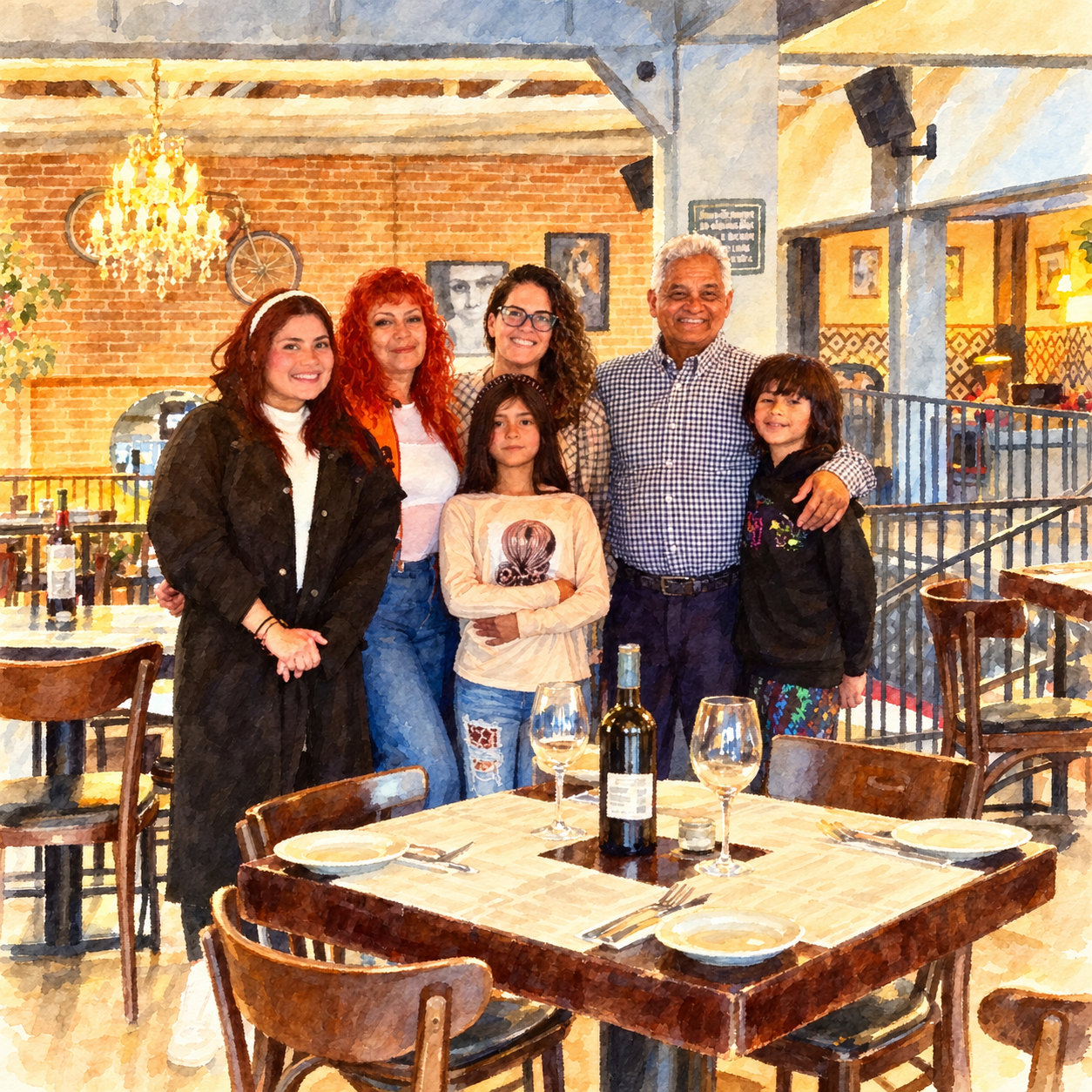
So sitting there in Bogotá, surrounded by the family of the man I loved, I did.
I told them what they meant to me.
I told them what their son meant to me.
I told them that these days in Colombia had changed something in me.
There was another part of it I don’t think I fully understood until later. I had known Fabricio for only three months when I boarded that plane. Three months. And somehow, there I was in Colombia, standing in front of the people who had loved him for his entire life, trying to be the representative he needed me to be because he could not be there himself.
I had gone for myself, certainly. I wanted to know his family and understand the places he came from. But I had also gone for him. I wanted his family to see that the woman he had chosen loved him, respected him, and understood what a privilege it was to be trusted with his heart. I wanted them to know that even though he could not come home, he had sent someone who would carry his love with her.
And I think I had done that.
And because I said it then, while we were all still sitting around a table eating pizza and taking pictures and pretending for just a little while longer that the night was an ordinary one, the goodbye that came later felt different.
I was heartbroken to leave them.
But I wasn’t frantic.
There wasn’t some enormous speech trapped inside me that I suddenly needed to deliver in an airport security line. I wasn’t going to reach the last possible moment and think, Wait. There is one more thing they need to know.
They already knew.
Everything I wanted to say, I had said.
Everything I had come to Colombia hoping to do, I had done.
There was sadness.
Enormous sadness.
But there was nothing unfinished about the trip.
And that, I think, made all the difference.
How Many Colombians Does It Take to Pack a Suitcase?
After dinner, we walked around Parque de la 93 for a while.
The night was beautiful. Fabricio’s sister took more pictures of me beneath Colombian flags, and we wandered through the park and surrounding streets taking still more photographs, stretching the evening out just a little longer.
Nobody seemed particularly eager to be the person who said it was time to go.
Eventually, though, there was no avoiding it.
Airport.
So we climbed back into the car: four adults, two children, an entirely normal-sized automobile, and what I had come to think of as the Colombian clown car making its final appearance.
By then I had become weirdly accustomed to it. Someone shifted. Someone held something. Someone squeezed in somewhere that did not appear, strictly speaking, to contain a seat. The doors closed.
Everyone survived.
Off we went.
When we arrived at El Dorado, my first priority was changing into something comfortable enough to spend the night on an airplane. We found a random bathroom near arrivals, and I disappeared into a stall carrying an armful of clothing before emerging in my travel jumpsuit feeling significantly more prepared for international transit.
Then I looked at my luggage.
And realized we had a problem.
For the first time, I was suddenly very aware of everything I was carrying home: the Colombian emeralds, jewelry, gifts from Fabricio’s family, things I had bought for him, keepsakes from the trip and objects I would be genuinely heartbroken to lose if an airline decided my suitcase would rather vacation somewhere else.
Dirty clothes could be checked.
Replaceable things could be checked.
The emeralds?
Absolutely not.
The gifts from his family?
Also no.
So there, in some random corner of El Dorado International Airport near a bathroom and nowhere remotely intended for this purpose, we opened everything.
Suitcases, carry-ons, bags, zippers, clothes, gifts and the accumulated debris of nearly a week of international travel suddenly spread around us.
And Fabricio’s family immediately went to work.
Someone held something while someone else rearranged something else. Things came out of one bag and disappeared into another. Somebody found room where I was certain there was no room. Important things migrated toward my carry-on; less important things were sacrificed to the checked suitcase.
I mostly stood there watching this highly efficient family operation unfold around my belongings.
Which raises an important question:
How many Colombians does it take to completely reorganize one American woman’s international luggage in under five minutes?
Apparently exactly the number I had brought with me.
Within minutes, everything was back together. The things I cared most about were safely staying with me, the things I could survive losing were checked, and the emeralds were secure.
Crisis avoided.
All we had to do now was find the airline counter.
This turned out to be slightly more complicated than my American airport brain expected because the counters weren’t permanently assigned to one airline. The screens changed according to the flights, which resulted in a small amount of pointing, walking, checking screens, walking back and pointing again.
Eventually we found it.
Correct counter. Bag checked. Everything handled.
And then, almost without warning, we ran out of things to do.
There was no more luggage to reorganize. No more dinner. No more errands. No practical problem left for six people to solve together.
There was only security.
And goodbye.
Until They Couldn’t See Me Anymore
This is the part I will never forget.
Once my suitcase was checked and there was nothing left to rearrange, solve or organize, we made our way toward security.
I assumed this was where they would leave.
Not because I wanted them to. Because that is simply how airports work in my mind. You get as close as you can. You hug. You cry. You say goodbye. The traveler joins the security line, and everyone else turns around and goes home.
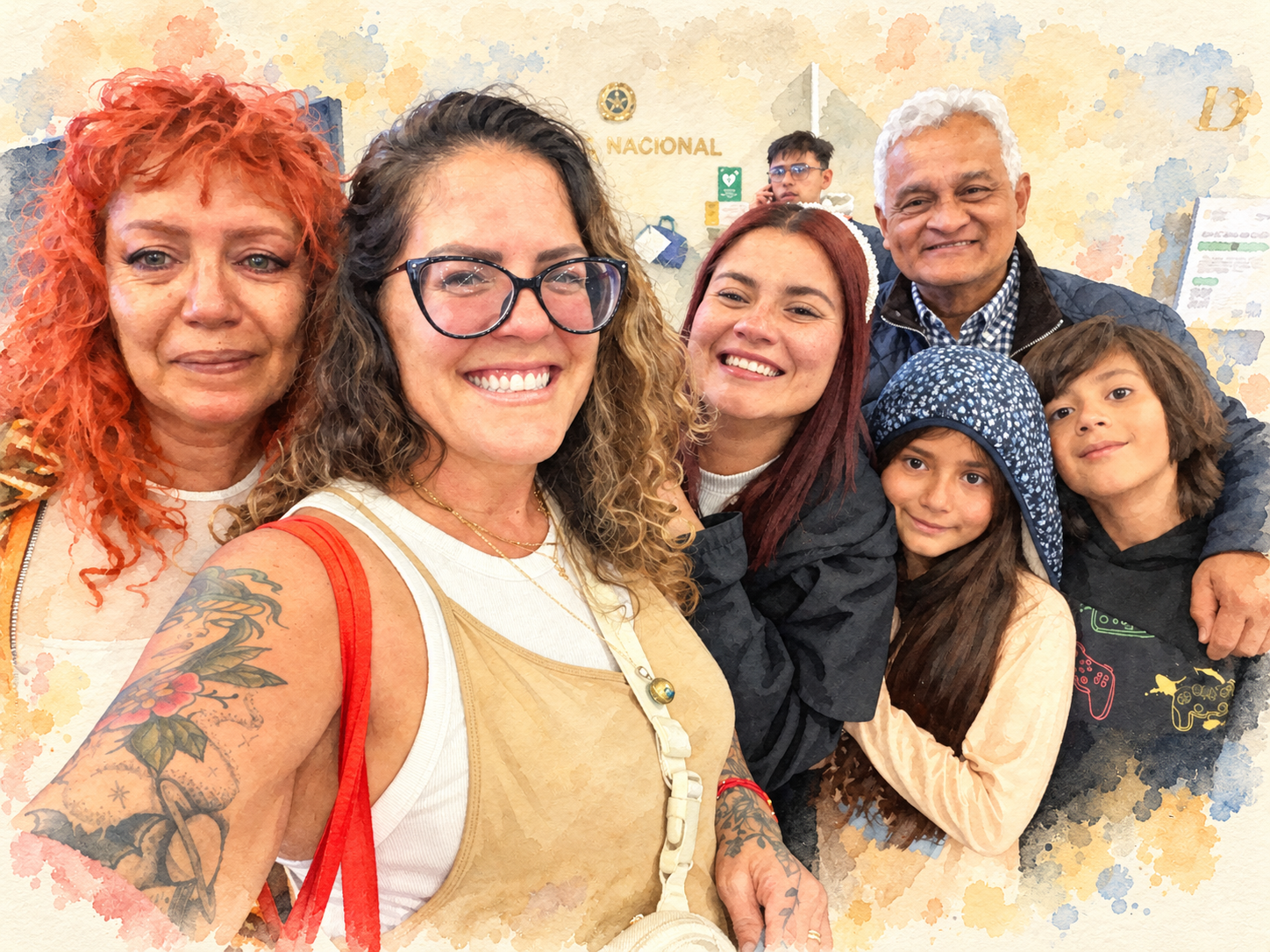
So we took one last photograph.
We hugged each other. We said goodbye. I tried to take in everybody’s faces one more time - the people who, only five days earlier, had been waiting for me on the other side of the glass with flowers, balloons and a sign.
Then I got into line.
A few minutes later, I turned around.
They were still there.
The line moved forward. I looked back again.
Still there.
I moved a little closer to security and turned around one more time.
Still there.
At first, I thought maybe they were just lingering. Maybe they wanted to make sure I got through without a problem. Maybe we were all having trouble being the first ones to actually walk away.
But the farther I moved through the line, the more I realized they weren’t going anywhere.
And then I started looking around.
They weren’t the only ones.
All along the edge of the security area were other families doing exactly the same thing. Parents watching children. Couples watching one another. Entire families gathered together, waving across the distance as their person slowly moved farther away.
Nobody seemed in a hurry to leave.
They were holding on to visual contact for as long as the airport would allow them to.
And suddenly I understood.
Fabricio’s family wasn’t waiting for the goodbye to be over.
They were waiting until there was literally no more goodbye left to have.
When I had arrived in Bogotá, they had gotten as close to me as they possibly could. Before I even had my suitcase, Fabricio’s mother had photographed me through the glass because they could already see me on the other side. They had stood there waiting with flowers and balloons and a sign, watching until the doors finally opened and I could walk into their arms.
Now, five days later, they were doing the reverse.
They had gotten me at the first human moment they could.
And they were going to keep me until the last one.
The line continued inching forward, and every few feet I turned around.
There they were.
I waved.
They waved back.
I blew kisses. They blew kisses.
I moved farther away, and they stayed exactly where they were.
There was something almost unbearably tender about it because none of us had decided, Okay, this is enough now.
Nobody had reached the point where we were ready.
We were simply running out of physical space in which we were allowed to remain connected.
Eventually I reached the point where I had to begin putting my things onto the conveyor belt for security. Shoes, bag, electronics, all the usual airport choreography.
But before I did, I stepped backward one last time.
I looked across the people between us and found them.
One more wave.
One more blown kiss.
One more I love you shouted across strangers who were doing versions of the exact same thing with their own families.
Then it was my turn.
I had to put my things on the belt. I had to walk through the metal detector. I had to keep moving toward my gate.
The airport had finally made the decision none of us wanted to make.
That was the goodbye.
Not because anyone had decided we had stood there long enough. Not because the crying was finished. Not because anyone was ready to turn around.
Because there were simply no more seconds available to us.
They had kept me until they couldn’t see me anymore.
And there is something about that I think I will carry for the rest of my life.
I wasn’t Fabricio.
I wasn’t their son or their brother. I wasn’t the person they had loved since the day he was born, the person whose childhood they remembered and whose absence from Colombia they carried with them.
I was his wife.
A woman who had appeared in his life only a few months earlier and then, almost impossibly, had gotten on an airplane without him and walked into theirs.
And still, they stood there for me.
They cherished those last few minutes with me as though there were no such thing as an unimportant one.
Maybe by then I wasn’t simply the American woman their son had married. Maybe loving Fabricio had connected all of us in ways I had not completely understood before I came.
And maybe there was something else happening too.
Fabricio couldn’t stand there with them.
He couldn’t make that trip home.
He couldn’t walk through Bogotá with his father, sit beside his mother in Saldaña, visit the family land or stand with all of us at the airport.
But I could.
For five days, I had carried him with me everywhere I went. In the calls. In the photographs. In the questions I asked. In the gifts he had sent. In the way his family looked at me and saw someone he had chosen.
And now, as they stood there refusing to leave until the airport forced us apart, I wondered if keeping me close for those last few minutes felt, in some small way, like keeping him close too.
I had arrived in Colombia thinking I was the one traveling toward them.
Standing on the other side of security, unable to see them anymore, I understood that they had been reaching toward me the entire time too.
And now I had to do the one thing I had come all this way eventually to do.
Go home to him.
♥️
