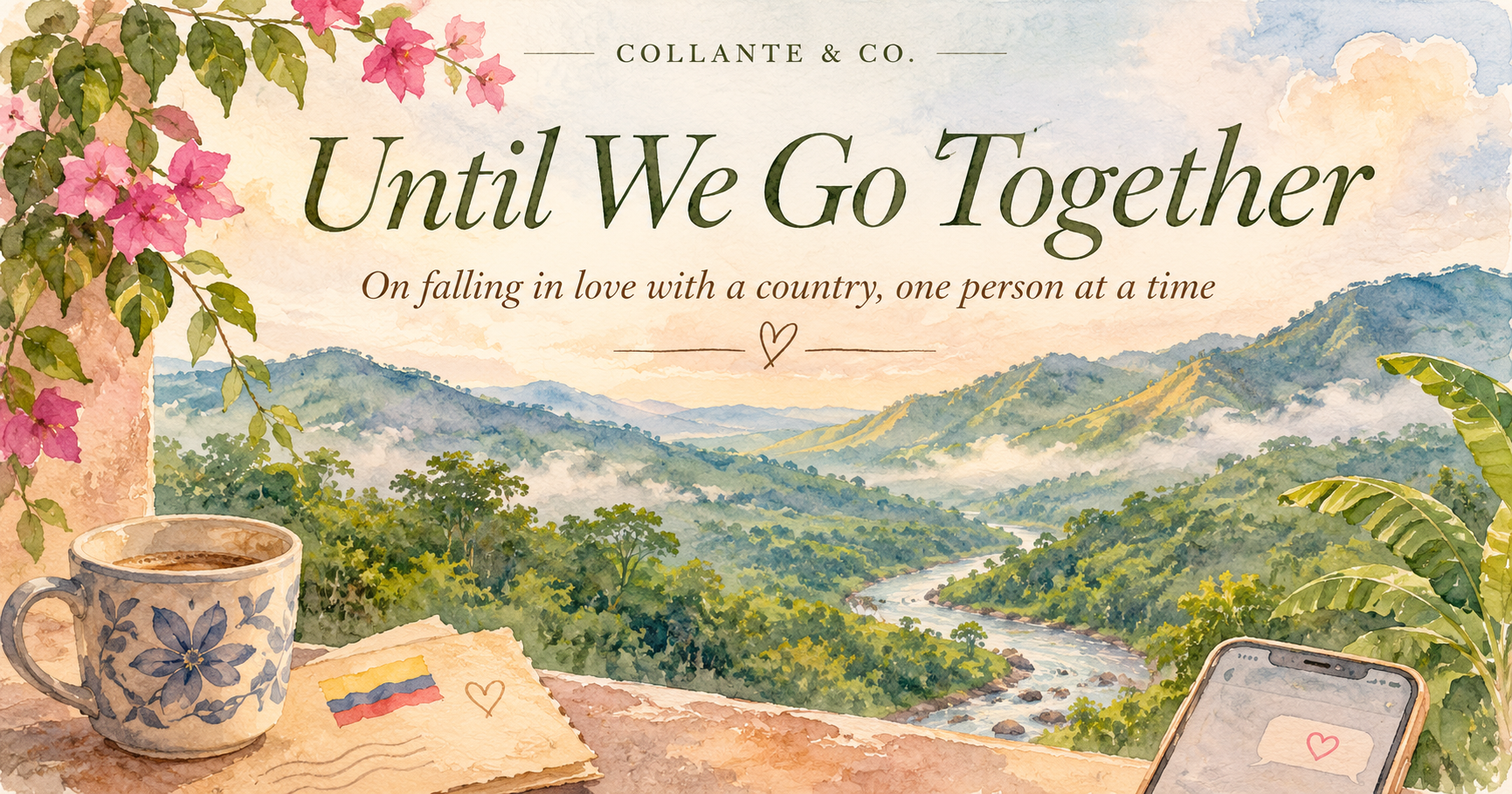
On falling in love with a country, one person at a time.
I think Colombia has found a new way to reach me. Apparently, it's through WhatsApp.
Recently, a man in western Boyacá sent us a video of the Río Minero, a river that winds through Colombia's emerald-producing region. He spoke about the people who search its banks, the remarkable emeralds they've discovered, and the families whose lives have been changed by what they've found. He also spoke about the region's darker history, the violence that marked parts of Colombia during the 1970s, 80s, and 90s, and why he believes it's important to remember that history without allowing it to define his home.
I was immediately captivated, not simply by the river or the possibility of emeralds hidden beneath its waters, but by the pride with which he spoke about his country.
It reminded me of something I wrote after my first trip to Colombia. As my plane descended toward Bogotá, I remember looking out the window at mountains, clouds, and an extraordinary amount of green, thinking about how much of what I'd heard about Colombia growing up in the United States had been connected to the darkest parts of its history.
Nobody had told me it looked like this.
And now, months after that first trip, here was another Colombian inviting me to look a little closer. To see something beyond the history I thought I knew, and to understand a place through the people who call it home.
The funny thing is that I never set out to fall in love with Colombia. I fell in love with a Colombian.
His name is Adan, and we married forty-six days after meeting. I realize that sounds like the beginning of a cautionary tale, but so far it's turned into a rather wonderful adventure.
When I traveled to Colombia for the first time, I went without him. I was newly married, spoke very little Spanish, and was about to spend several days with his family, most of whom I had only ever seen through the screen of his phone.
Except they didn't really feel like strangers.
For months, they'd been part of our everyday lives through WhatsApp calls, messages, photographs, and conversations that occasionally required an extraordinary amount of translation. I knew their faces, their voices, and little details about their lives. They knew me, too, or at least enough to have apparently decided I belonged to them long before I arrived.
And that's something I've come to appreciate about the Colombian people who have welcomed me into their lives.
Once they decide you're theirs, you're theirs.
There doesn't seem to be an elaborate application process. Nobody explains the requirements or schedules a probationary period. You're simply included. You're invited into their homes, introduced to relatives, fed until you're reasonably certain your digestive system has reached its legal capacity, and treated as though you've always been part of the family.
By the time I left Colombia, I was Mi Molly to his family, had more memories than I knew what to do with, and was carrying five homemade arepas carefully through an international airport for my husband.
I had gone to Colombia to meet his family. I came home feeling that I'd found another one.
And almost immediately, I wanted to go back.
But this time, I want to go with Adan.
I want to walk through the places I've already visited with the man who spent so much of our first trip experiencing them through my phone. I want to sit with his mother while he's sitting beside us, instead of thousands of miles away in Arizona. I want to watch him with the people who have known him all his life, hear their stories together, and see the little things about him that only become visible when someone returns to the place they came from.
I especially want to go back to Saldaña, where I walked the land that matters so much to his family and saw the place where he hopes to build a home for his mother. I want to stand there with him. Not with a phone pointed toward the landscape so he can see what I'm seeing, but with his hand in mine.
And the difficult part is that I don't know when we'll be able to do that.
There are uncertainties in our lives that make planning a trip to Colombia far more complicated than choosing dates and purchasing airline tickets. We talk about going back. We imagine what we'll do and whom we'll visit. But we can't yet circle a date on the calendar and know that it's ours.
It's a strange thing to long for a trip you can't quite plan, especially when so much of what you're longing for isn't sightseeing or adventure, but the simple experience of being together with people you love.
In the meantime, something unexpected keeps happening.
Colombia keeps getting bigger.
What began with Adan's family has gradually expanded into other relationships, other communities, and places I hadn't even heard of a few months ago. Through our growing involvement with Colombian emeralds, we're meeting people who are sharing their knowledge, their work, their hometowns, and their hopes with us.
Now there are faces in western Boyacá that are becoming familiar. There are names and places appearing in our conversations, videos arriving from landscapes I've never seen, and people I'm genuinely excited to meet.
Once again, I'm getting to know people before I've had the opportunity to shake their hands or sit across a table from them.
And I find that incredibly moving.
There's something intimate about being invited into another person's world before you've ever physically entered it. You begin to recognize the way someone speaks, the things they care about, and the pride they take in showing you where they come from. A place that was once nothing more than a name on a map begins to feel personal because someone you know lives there.
That's what happened with Adan's family. And somehow, it's happening again.
The Río Minero is no longer simply a river in a region famous for emeralds. It's a place someone has taken the time to show us, a place connected to generations of lives, discoveries, struggles, and stories.
I want to see it. I want to understand more about the people who live and work there. I want to learn about the history that our new Colombian friends are so eager to share, including the parts that aren't beautiful or easy to talk about.
Because I think there's a difference between admiring a country and becoming genuinely interested in understanding it. Loving a place doesn't require pretending its history is uncomplicated. Sometimes it means caring enough to listen to the whole story.
And perhaps that's what has surprised me most about this chapter of my life.
I began by falling in love with a man. I wanted to know his family, understand his language, experience his traditions, and discover the places that had shaped the person I married.
Somewhere along the way, those interests became my own.
I'm not simply learning about Colombia because it's where my husband was born anymore. I'm learning about it because I've developed relationships with people there, because their stories interest me, because there are places I want to discover for myself, and because every new connection gives me another reason to return.
What began as a love story with a man I married just 46 days after we met has quietly become a love affair with an entire country.
And I don't know exactly when the next chapter will begin.
I don't know when Adan and I will finally step off a plane in Bogotá together, or when we'll make our way to Saldaña, or when we'll find ourselves standing beside the Río Minero with the people who first showed it to us through a phone.
But I do know that when we finally go, we'll be returning to a country that has continued making room for us, even while we've been far away.
And I love that.
Because somehow, without ever leaving Arizona, I've begun to feel connected to another little corner of Colombia.
Apparently, that's what happens when Colombians decide you're theirs.
They just keep finding more places for you to belong.
♥️
